


Jazz is “America’s Music.” Established in the early 1900s, the music has remained popular for nearly a century, going through many variations.
In the 1920s, jazz was “pop” music, but today it is often shunned by younger people in favor of today’s popular tunes — rap, rock and country. Can jazz, with its broad history and reputation for being “art” music, be relevant to youth today?
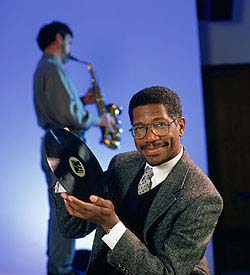
The director of a summer jazz institute at Washington University in St. Louis hopes to show that jazz is not only relevant, but also essential.
Some of the country’s leading scholars of jazz and American culture will be teaching at WUSTL’s National Endowment for the Humanities Summer Institute for High School Teachers July 2-27.
“‘Teaching Jazz as American Culture’ will offer participants an exciting opportunity to learn about one of the most extraordinary art forms the United States has ever produced,” says Gerald L. Early, Ph.D., Washington University’s Merle Kling Professor of Modern Letters and director of the summer institute.
The primary goal of the institute, says Early, is to “work with 30 public high school teachers to show how, through the study of the social, cultural, technical and aesthetic history of a major American musical genre — jazz — they can rethink aspects of teaching history, literature, music, art and film while broadening students’ understanding of the political, social and commercial impact that an artistic movement can have. Participants will develop lesson plans for their subject area using aspects of jazz.”
Participants come from various academic disciplines, including English, history, social studies, art and music.
Early, who is a professor of English, of African & African American Studies and of American Culture Studies, all in Arts & Sciences, has written extensively on jazz. He served as a consultant for Ken Burns’ “Jazz” and he contributed an essay to the book that accompanied that PBS series.
In 2004, Early received a $220,000 grant from the National Endowment for the Humanities’ Division of Education Programs to host the institute under the auspices of Washington University’s Center for the Humanities in Arts & Sciences, which Early directs.
‘Compelling story’
“Jazz can teach us so much about ourselves,” says Early. “It affords us a compelling story about the relationship between art and commerce. It also tells the story of race in America and it raises questions about gender and popular music.”
Institute participants will learn about the geography of jazz, jazz and the civil rights movement, bebop, jazz after World War II, jazz abroad and jazz in literature, among other topics. Early points out that the institute is intended to have teachers re-imagine how popular culture can be taught.
Participants will also get the opportunity to hear weekly live jazz performances at Jazz at the Bistro, a nonprofit nightclub and educational initiative in St. Louis that provides a venue for nationally known jazz musicians to perform and to educate at local schools.
“This institute does not simply ask the question, ‘What is jazz?'” says Early. “It asks as well how jazz became so uniquely tied to American national life and character, how jazz shaped and defined 20th-century American life and how people in other countries look at jazz.
“We hope that those who attend can take what they learn back to their classrooms and impart it to the next generation of jazz music lovers.”
Editor’s note: Gerald Early is available for live or taped interviews using Washington University’s free VYVX or ISDN lines.