
Record current issueAssembly Series

Gargoyle

  -  Faculty Experts


  -  News by Topic

  -  News by School


Search News & Info


WUSTL in the News
  - Powered by Google


WUSTL Home

Public Affairs Home

News
Releases

University News

Medical News

Sports News

Radio Service

Tip Sheets

Business, Law & Econ

Culture & Living

Science & Technology
Media Resources
Contact Information

TV/Radio Studio

Visiting Our Campuses

Campus Images

Sports photography
Commercial Filming
   and Photography


Commercial Use of
   Names and Symbols

Domain Name policy
WUSTL Information
Record (newspaper)

Campus Calendars

WUSTL News Summary

Publications Online

Facts, Guides & Maps


Washington University in St. Louis News & Information > News Tips >

Studies affirm relationship between early humans, Neandertals

Social equals

By Neil Schoenherr

June 14, 2007 -- For nearly a century, anthropologists have been debating the relationship of Neandertals to modern humans. Central to the debate is whether Neandertals contributed directly or indirectly to the ancestry of the early modern humans that succeeded them.
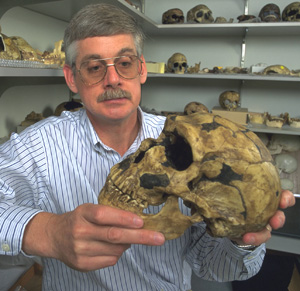
Erik Trinkaus, WUSTL professor of anthropology in Arts & Sciences, holding a Neandertal skull, says the evidence is very convincing that Neandertals and early humans mixed.
Joe Angeles/WUSTL Photo
Erik Trinkaus, WUSTL professor of anthropology in Arts & Sciences, holding a Neandertal skull, says the evidence is very convincing that Neandertals and early humans mixed.
Download

As this discussion has intensified in the past decades, it has become the central research focus of Erik Trinkaus, Ph.D., professor of anthropology at Washington University in St. Louis.

Trinkaus has examined the earliest modern humans in Europe, including specimens in Romania, Czech Republic and France. Those specimens, in Trinkaus' opinion, show obvious Neandertal ancestry.

In an article that appeared in the April 23, 2007, Proceedings of the National Academy of Sciences, Trinkaus has brought together the available data, which shows that early modern humans did exhibit evidence of Neandertal traits.

"When you look at all of the well-dated and diagnostic early modern European fossils, there is a persistent presence of anatomical features that were present among the Neandertals but absent from the earlier African modern humans," Trinkaus said. "Early modern Europeans reflect both their predominant African early modern human ancestry and a substantial degree of admixture between those early modern humans and the indigenous Neandertals."

This analysis, along with a number of considerations of human genetics, argues that the fate of the Neandertals was to be absorbed into modern human groups. Equally important, it also says that the behavioral difference between the groups was small. They saw each other as social equals.


View Current: Business, Law & Economics | Culture & Living | Medical Science & Health | Science & Technology


Related Information
Media Assistance:

Tony Fitzpatrick
Senior Science Editor
tony_fitzpatrick@wustl.edu

(314) 935-5272

Subject Matter Experts:

Related Links:
Erik Trinkaus' Web site
Earliest modern humans in Europe found
China's earliest human puts 'out of Africa' theory to test
The Genes We Share - an animated Neandertal site

Related Groups:

Schools:
Arts & Sciences

Departments:
Anthropology
Biology

- View All Groups

Related Topics:
Anthropology
Culture & Living
Evolution
Genetics
Science & Technology

- View All Topics

Revised:

Tuesday, July 31, 2007


  Email this page

  Print ready page


News & Information  |   Medical News  |   Office of Public Affairs  |   WUSTL Home

Please contact us and let us know how we can assist you.
Technical problems with this Web site? Email questions or comments.
Please review the WUSTL News & Information copyright/privacy policy.