


Spending by federal regulatory agencies will exceed the growth of the overall federal budget, according to Regulators’ Budget Continues to Rise: An Analysis of the U.S. Budget for Fiscal Years 2004 and 2005, this year’s edition of the annual report on regulatory spending and staffing by the Weidenbaum Center’s Melinda Warren and Mercatus Center’s Susan Dudley. This report analyzes projected spending and staffing for the 63 regulatory agencies as proposed in President Bush’s 2005 Budget of the United States Government.
The Budget Message of the President articulates “three overriding national priorities: winning the war on terror, protecting the homeland, and strengthening the economy.” The “Overview of the President’s 2005 Budget” highlights a goal of limiting discretionary spending:
For the second year in a row, the President’s Budget is built on the sensible premise that government spending should grow no faster than the average increase in American family incomes of approximately 4%. This Budget proposes to hold the growth in total discretionary spending to 3.9% and to reduce the growth in non-defense, non-homeland security spending to 0.5%, below the rate of inflation.
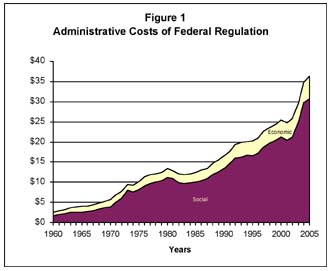
The regulators’ budget, the portion of the new budget directed at administering and enforcing federal regulations, exceeds the 3.9% overall goal. The 2005 Budget requests outlays for federal activities of $39.1 billion, a 4.2% real increase over the appropriated 2004 Budget. The 2004 regulators’ budget of $37.1 billion represents a 6% decline from FY2003, when the budget reached $39 billion.
Melinda Warren, director of the Weidenbaum Center Forum and a study co-author pointed out that: “Expenditures of federal regulatory agencies and the trends in this regulatory spending over time, as tracked in this report, are a proxy for the size and growth in regulations with which American businesses, workers, and consumers must comply. This information can serve as a barometer of regulatory activity, providing policy makers and others with useful insights into the composition and evolution of regulation.”
Susan Dudley, director of the Regulatory Studies Program at the Mercatus Center and the study’s other co-author notes, “Despite the stated focus on homeland security and strengthening the economy, the agency with the largest increase in the regulators’ budget is the Environmental Protection Agency. EPA will add $667 million to its budget in 2005. Other agencies adding more than $100 million to their 2005 budget are Homeland Security’s Immigration and Customs Enforcement and Coast Guard, the Securities and Exchange Commission, the Patent and Trademark Office, the Food and Drug Administration, and the Bureau of Alcohol, Tobacco, Firearms, and Explosives.”
Warren and Dudley also track the number of people needed to run the federal regulatory agencies. The requested level of staffing in fiscal year 2005 is 242,473 full-time employees, representing an increase of 2,849 people (1.2 percent) since 2004, and a 42 percent increase over staffing levels in 2001. The Transportation Security Administration’s employment of over 56,000 airport screening agents in 2003 is largely responsible for the big increase in regulatory staffing.
A joint product of the Weidenbaum Center at Washington University in St. Louis and the Mercatus Center at George Mason University, this report continues an effort begun in 1977 by the Weidenbaum Center (formerly the Center for the Study of American Business.) The full report is online at both the Weidenbaum Center (http://wc.wustl.edu) and Mercatus Center (www.mercatus.org) websites by the end of July.
———————————————————-
For more information or a complete copy of the study, please call Gerry Everding at (314) 935-6375 or Carrie Conko at (703) 993-4899 or log on to the web site of the Weidenbaum Center (http://wc.wustl.edu) or the Mercatus Center (http://wc.wustl.edu ).
The Weidenbaum Center on the Economy, Government, and Public Policy at Washington University in St. Louis supports scholarly research, public affairs programs, and other activities in the fields of economics, government, and public policy, serving as a bridge between scholars and policy makers.
The Mercatus Center is an education, research, and outreach program at George Mason University that works with scholars, policy experts, and government officials to bridge academic theory and real-world practice.