
Record current issueAssembly Series

Gargoyle

  -  Faculty Experts


  -  News by Topic

  -  News by School


Search News & Info


WUSTL in the News
  - Powered by Google


WUSTL Home

Public Affairs Home

News
Releases

University News

Medical News

Sports News

Radio Service

Tip Sheets

Business, Law & Econ

Culture & Living

Science & Technology
Media Resources
Contact Information

TV/Radio Studio

Visiting Our Campuses

Campus Images

Sports photography
Commercial Filming
   and Photography


Commercial Use of
   Names and Symbols

Domain Name policy
WUSTL Information
Record (newspaper)

Campus Calendars

WUSTL News Summary

Publications Online

Facts, Guides & Maps


Washington University in St. Louis News & Information > News Tips >

Protein found that rallies biological clock

Pony Express protein

By Tony Fitzpatrick

Feb. 7, 2007 -- A biologist at Washington University in St. Louis and his collaborators have identified the factor in mammalian brain cells that keeps cells in synchrony so that functions like the wake-sleep cycle, hormone secretion and loco motor behaviors are coordinated daily.

Erik Herzog, Ph.D., Washington University associate professor of Biology in Arts & Sciences, Sara Aton, Ph.D., a graduate student in Herzog's lab who is now a postdoctoral researcher at the University of Pennsylvania, James Huettner, Ph.D., associate professor in cell biology and physiology at the Washington University School of Medicine, and Martin Straume, a biostatistician, have determined that VIP — vasoactive intestinal polypeptide — is the rallying protein that signals the brain's biological clock to coordinate daily rhythms in behavior and physiology.
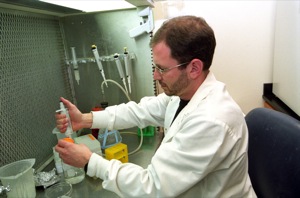
Erik Herzog  and his collaborators have identified the factor in mammalian brain cells that keeps cells in synchrony so that functions like the wake-sleep cycle, hormone secretion and loco motor behaviors are coordinated daily. It's called VIP — vasoactive intestinal polypeptide —  the rallying protein that signals the brain's biological clock to coordinate daily rhythms in behavior and physiology.
Eric Chou
Erik Herzog and his collaborators have identified the factor in mammalian brain cells that keeps cells in synchrony so that functions like the wake-sleep cycle, hormone secretion and loco motor behaviors are coordinated daily. It's called VIP — vasoactive intestinal polypeptide — the rallying protein that signals the brain's biological clock to coordinate daily rhythms in behavior and physiology.
Download

The finding clarifies the roles that both VIP and a neurotransmitter GABA play in synchronizing biological clocks, and sheds light on how mammals, in this case mice and rats, regulate circadian rhythm. Results were published in the Nov. 27- Dec. 1 online issue of the Proceedings of the National Academy of Sciences.

Neurons in the biological clock, an area called the suprachiasmatic nucleus (SCN), located at the base of the brain right across the optic nerve, keep 24-hour time and are normally highly synchronized. The SCN is composed of 10,000 neurons on one side of the hypothalamus, and 10,000 on the other. Together these neurons are intrinsic clocks in communication with each other to keep 24-hour time.

It had been thought that GABA was the prime candidate for the rallying role. All SCN neurons make this inhibitory neurotransmitter, and it had been shown that giving GABA daily at 8 a.m. to SCN cells synchronizes them.

"The surprise was that GABA was not needed," said Herzog. "VIP synchronizes even when we block all GABA signaling. When we blocked GABA, synchrony was perfectly fine. Instead, the oscillations got bigger."

Herzog likens VIP to the Pony Express rider telling all the SCN cells to synchronize their watches; GABA, he says, is like the marshal that prevents the cells from being too active.

Herzog and Aton recorded neuron activity from the SCN using a multielectrode array with 60 electrodes upon which they place SCN cells, a "clock in a dish." They also recorded gene expression in real-time using a bioluminescent reporter of gene activity.

Using drugs or genetic knock out mice, they negated the role of GABA and recorded the electrical activity of many neurons, what Herzog calls the "hands of the clock," and the gene activities, "the cogs of the clock," of many SCN cells.

They found that, without GABA, the cells marched together, but without VIP, they lost synchrony, indicating that VIP is the coordinator.


View Current: Business, Law & Economics | Culture & Living | Medical Science & Health | Science & Technology


Related Information
Media Assistance:

Tony Fitzpatrick
Senior Science Editor
tony_fitzpatrick@wustl.edu

(314) 935-5272
Subject Matter Experts:

Related Links:
Herzog laboratory
Related research: temperature and light in biological clocks
WUSTL Center for Aging
WUSTL Neuroscience Program
Outlook magazine story on circadian rhythm

Related Groups:

Schools:
Arts & Sciences
School of Engineering & Applied Science
School of Medicine

Departments:
Biology
Biomedical Engineering
Chemistry
Neurology

- View All Groups

Related Topics:
Aging
Aging and Mental Health
Brain / Neuro / Spinal
Chemistry
Culture & Living
Evolution
Life Sciences
Medical Science
Science & Technology

- View All Topics

Revised:

Friday, March 9, 2007


  Email this page

  Print ready page


News & Information  |   Medical News  |   Office of Public Affairs  |   WUSTL Home

Please contact us and let us know how we can assist you.
Technical problems with this Web site? Email questions or comments.
Please review the WUSTL News & Information copyright/privacy policy.