
Record current issueAssembly Series

Gargoyle

  -  Faculty Experts


  -  News by Topic

  -  News by School


Search News & Info


WUSTL in the News
  - Powered by Google


WUSTL Home

Public Affairs Home

News
Releases

University News

Medical News

Sports News

Radio Service

Tip Sheets

Business, Law & Econ

Culture & Living

Science & Technology
Media Resources
Contact Information

TV/Radio Studio

Visiting Our Campuses

Campus Images

Sports photography
Commercial Filming
   and Photography


Commercial Use of
   Names and Symbols

Domain Name policy
WUSTL Information
Record (newspaper)

Campus Calendars

WUSTL News Summary

Publications Online

Facts, Guides & Maps


Washington University in St. Louis News & Information > News Tips >

More human-Neandertal mixing evidence uncovered

By Neil Schoenherr

Nov. 9, 2006 -- A re-examination of ancient human bones from Romania reveals more evidence that humans and Neandertals interbred.
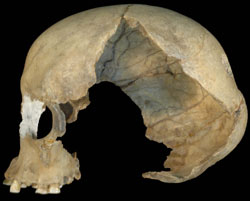
The early modern human cranium from the Pestera Muierii, Romania.
Photo courtesy Muzeul Olteniei / Erik Trinkaus
The early modern human cranium from the Pestera Muierii, Romania.
Download

Erik Trinkaus, Ph.D., the Mary Tileston Hemenway Professor in Arts & Sciences at Washington University in St. Louis, and colleagues radiocarbon dated and analyzed the shapes of human bones from Romania's Pestera Muierii (Cave of the Old Woman). The fossils, which were discovered in 1952, add to the small number of early modern human remains from Europe known to be more than 28,000 years old.

Results were published in a recent issue of the Proceedings of the National Academy of Science.

The team found that the fossils were 30,000 years old and principally have the diagnostic skeletal features of modern humans. They also found that the remains had other features known among potential ancestors, primarily among the preceding Neandertals, providing more evidence that there was mixing of humans and Neandertals as modern humans dispersed across Europe about 35,000 years ago.

Their analysis of one skeleton's shoulder blade also shows that these humans did not have the full set of anatomical adaptations for throwing projectiles, like spears, during hunting.

Erik Trinkaus
Erik Trinkaus

The team says that the mixture of human and Neandertal features indicates that there was a complicated reproductive scenario as humans and Neandertals mixed, and that the hypothesis that the Neandertals were simply replaced should be abandoned.

Article #08443: "Early Modern Humans from the Pestera Muierii, Baia de Fier, Romania" by Andrei Soficaru, Adrian Dobo and Erik Trinkaus.


View Current: Business, Law & Economics | Culture & Living | Medical Science & Health | Science & Technology


Related Information
Media Assistance:

Neil Schoenherr
News Writer; Assoc. Record Editor
nschoenherr@wustl.edu

(314) 935-5235
Subject Matter Experts:

Related Links:
Trinkaus Web site
Oldest cranial fossils of early modern humans
Evolution's odd man out
Earliest modern humans in Europe found
Re-dated Neandertal fossils

Related Groups:

Schools:
Arts & Sciences

Departments:
Anthropology
Biology

- View All Groups

Related Topics:
Evolution
Science & Technology

- View All Topics

Revised:

Monday, Dec. 11, 2006


  Email this page

  Print ready page


News & Information  |   Medical News  |   Office of Public Affairs  |   WUSTL Home

Please contact us and let us know how we can assist you.
Technical problems with this Web site? Email questions or comments.
Please review the WUSTL News & Information copyright/privacy policy.