


Steven Spielberg, eat your heart out.
A team consisting of an art student and mechanical engineers at Washington University in St. Louis has made an award-winning movie that captures for the first time the fluid mechanics phenomenon of two things that classically don’t mix, doing just that.

Amy Shen, Ph.D., assistant professor of mechanical engineering, her graduate student William Alexander and School of Art senior Sarah Roland, have photographed three different oils atop a layer of water and the consequence of what happens when water and oil are forced to react through the spin of a magnetic stir bar.
Guess what? It looks just like a tornado. Double click on the images and take a look: http://mesun4.wustl.edu/ME/faculty/aqshen/news.html
The three-minute video, set to the rock music of Soundgarden, catches canola oil, STP oil and STP oil additive doing what they don’t confess, and is so visually appealing that it won the Gallery of Fluid Motion Award at the American Physical Society’s (APS) annual meeting in November, 2003 in East Rutherford, N.J. APS holds the competition, which can be either a poster or a video, annually; Shen and her collaborators were one of 11 teams out of 88 who competed to win an award. Shen’s results will be published later in 2004 in the journal Physics of Fluids.
She recruited Roland to the project when she and two other Washington University faculty members purchased a Photron PCI 1280 digital high speed camera that shoots 1,000 frames per second (at 1,024 by 1,248 resolution) compared with the 30 frames per second of a typical digital camera.
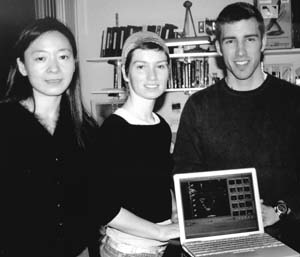
“I wanted to have someone work with us who was really proficient with a camera and would value the beauty of the action,” Shen said. “Sarah was invaluable.”
Shen’s specialty is fluid dynamics of complex fluids, an interdisciplinary area involved in many natural and synthetic processes from hand-held sensing devices to automobiles, to biomedical equipment. The transport of fluid and heat occurs everywhere, for instance, in the environment and all living organisms. Fluids are either Newtonian — their viscosity is constant, despite perturbation — or non-Newtonian — their viscosity changes and is less easy to predict. Canola oil is Newtonian and the STP products are non-Newtonian.
The three different oils all produced different vortices, or funnels. Canola oil is the smoothest, characterized by satellite droplets, and looking like a classic tornado about to touch down; STP fuel treatment is a little rougher with irregular satellites; and the oil treatment is the most elastic, looking like the dissolving of a funnel cloud.
“When you see the movie, everything makes sense,” Shen said. “The purpose of the competition is to illustrate a fluid motion that shows originality and ability to convey the fundamental fluid transport phenomenon. The most common reaction we got was: ‘I should have done that.’ I think it’s a nice educational demonstration of fundamental research with up-to-date technology.”