
Record current issueDebate 08

Gargoyle

  -  Faculty Experts


  -  News by Topic

  -  News by School


Search News & Info


WUSTL in the News
  - Powered by Google


WUSTL Home

Public Affairs Home

News
Releases

University News

Medical News

Sports News

Radio Service

Tip Sheets

Business, Law & Econ

Culture & Living

Science & Technology
Media Resources
Contact Information

TV/Radio Studio

Visiting Our Campuses

Campus Images

Sports photography
Commercial Filming
   and Photography


Commercial Use of
   Names and Symbols

Domain Name policy
WUSTL Information
Record (newspaper)

Campus Calendars

WUSTL News Summary

Publications Online

Facts, Guides & Maps


Washington University in St. Louis News & Information > News Tips >

Ten Commandments have no place on government property, says religious studies expert

By Neil Schoenherr

March 2, 2005 -- The U.S. Supreme Court is again considering whether it is constitutional to display the Ten Commandments on public property.

An expert on the American religious experience from Washington University in St. Louis argues that the only way to allow all citizens to contribute to this country's religious tapestry is for religion not to have a direct role in civil affairs and on government property.
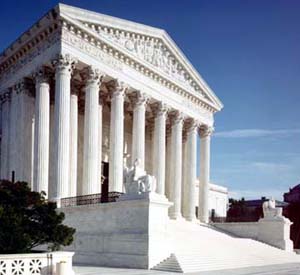
"If there is anything the Founding Fathers wanted to avoid, it was a repeat of the wars of religion that wracked Europe during the 16th and 17th centuries," says Frank K. Flinn, Ph.D., adjunct professor of religious studies in Arts & Sciences. "How could they avoid that? By dividing the interests of the state from the interests of religion and letting each do their own thing in their proper sphere to the benefit of the whole."

In 2003, the Supreme Court let stand a lower court decision ordering the State of Alabama to remove a granite memorial of the Ten Commandments that had been installed in the foyer of the Alabama Supreme Court.

The court has agreed to hear two new cases on March 2. The first involves a Ten Commandments monument placed on governmental state property between the Texas State Capitol and the Texas Supreme Court.

The second case involves framed displays of the Commandments in the McCreary and Pulaski County courthouses and Harlan County schools in Kentucky.

In both the Texas and Kentucky cases, the text of the Bible used is the King James Version of Exodus 20:1-17, says Flinn. But there are three different sets of the Commandments in the Bible alone: Exodus 20:1-17, Deuteronomy 5:6-21; and Exodus 34:11-26. There is also a variant in Leviticus 19 and Exodus 34 that contains the Ritual Decalogue and is important to devout Jews.

The Ten Commandments are often referred to as the Decalogue. This is a word derived from the Greek deka, which means ten, and logos, which means word.

"The question now becomes: Which list merits hanging on the wall and who has the authority to decide this? Orthodox Jews assert that there are actually 613 mitzvot or commandments throughout the Torah. Why not include all of these?" asks Flinn.

"Immediately, without going outside the Bible itself, we find ourselves caught up in religious controversy," he says. "Protestants and Catholics favor the first two lists, while Jews attend to the third. If we opt for the former, then, we are in effect establishing Christianity at the expense of Judaism as the officially sanctioned religion of the community."

Frank K. Flinn
Frank K. Flinn
Download

Flinn argues that the decision to hang one version or the other of the Decalogue flies in the face of the First Clause of the First Amendment: "Congress shall make no law respecting an establishment of religion ... ."

"Some argue that tacking up one version over another is only a little inconvenience to unrepresented religious groups," Flinn states. "The prohibition, however, is one of the rare absolutes in the Constitution: 'no law.' Not a little, inconvenient law; no law."

Asking the state to arbitrate which version gets posted in public is to invite government into an imbroglio of entanglement that is worse than excessive; it promises to be destructive of civil peace, he warns.

"American Hindus subscribe to the Laws of Manu, Buddhists to the Code of the Bodhisattva, and Muslims to the Shariah. Why not post them?" Flinn asks. "By their own admission, the devout Christian champions of the Ten Commandments not only would not agree to posting the law codes of other religions, they would positively fight posting them, thus dragging the state into open religious disputes."


View Current: Business, Law & Economics | Culture & Living | Medical Science & Health | Science & Technology


Related Information
Media Assistance:

Neil Schoenherr
News Writer; Assoc. Record Editor
nschoenherr@wustl.edu

(314) 935-5235
Subject Matter Experts:

Related Links:
Frank Flinn's Web page
U.S. Supreme Court Web page

Related Groups:

Schools:
Arts & Sciences

Programs:
Religious Studies

- View All Groups

Related Topics:
Culture & Living
Law & Legal Issues
Religious Issues
Supreme Court

- View All Topics

Revised:

Monday, April 11, 2005


  Email this page

  Print ready page


News & Information  |   Medical News  |   Office of Public Affairs  |   WUSTL Home

Please contact us and let us know how we can assist you.
Technical problems with this Web site? Email questions or comments.
Please review the WUSTL News & Information copyright/privacy policy.