


Biologists at Washington University in St. Louis have discovered an entirely new cellular “machine” in plants that plays a significant role in plant flowering and DNA methylation, a key chemical process essential for an organism’s development.

A team headed by Craig Pikaard, Ph, D., Washington University professor of biology in Arts & Sciences, has discovered a fourth kind of RNA polymerase found only in plants and speculated to have been a plant feature for more than 200 million years.
RNA polymerase is an enzyme, or protein machine, essential for carrying out functions of cells and for expression of biological traits. It does its job by copying a template of DNA genetic information in order to make RNAs that encode proteins or that function directly in the cell.
Biologists have studied three kinds of RNA polymerase for decades in organisms ranging from brewer’s yeast to humans. In all eukaryotes, the RNA polymerases Pol I, II, and III perform the same distinct, though separate, functions in different species.
But then along came Pol IV.
Pikaard first noticed the evidence for a fourth polymerase when analyzing gene sequences after Arabidopsis thaliana, the “laboratory rat” of the plant world, was sequenced in 2001. It originally looked to him like an alternative form of either Polymerase I (Pol I), which makes the largest of the ribosomal RNAs, Pol II which makes RNAs for protein-coding genes, or Pol III, a specialist in making the shortest of the ribosomal RNAs and tRNAs.
The Big Subunit
He and his colleagues looked specifically at two polypeptides that would be the key subunits if the fourth polymerase were functional, namely the largest and second largest subunits, what Pikaard refers to as the catalytic, or “business end” of any known polymerase.
“So, we took a reverse-genetics approach” said Pikaard. “We thought: ‘What happens if we knock these genes out?’ So, we knocked out the genes responsible for these subunits and there were no huge consequences. The plants survived, but there were slight delays in flowering and some strange floral defects. The plants were having trouble with organ identity — stamens tried to turn into petals, for instance. Our first hypothesis was that the fourth polymerase was involved with what are known as micro RNAs, which are known to regulate flower development, but that proved wrong.”
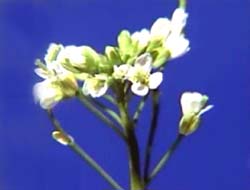
In a series of genetic and biochemical tests, Pikaard and his collaborators discovered that Pol IV does not share in the duties of Pol I, II or III. But when the Pol IV subunits are knocked out, the most tightly packed DNA in the nucleus becomes less condensed, small RNAs called siRNAs corresponding to highly repeated 5S rRNA genes and retrotransposons (jumping genes) are completely eliminated and DNA methylation at 5S genes and retrotransposons is lost.
Methylation is a vital process involving a chemical modification in cytosine, one of the four chemical subunits of DNA. Without proper DNA methylation, higher organisms from plants to humans have a host of developmental problems, from dwarfing in plants to tumor development in humans to certain death in mice. Pikaard thinks that Pol IV helps make siRNAs that then direct DNA methylation to sequences matching the siRNAs.
The results were published in Cell online, Feb. 10, 2005 and will appear in the March, 2005 print version of the journal.
“Pol IV is somehow involved in maintaining the integrity of the Arabidopsis genome, principally in keeping the silent DNA silent,” Pikaard said.
“Plants can get by without Pol IV, whereas they can’t do without the other three. We don’t see anything obviously like Pol IV in any other genome, but it’s possible it might have been overlooked.”
While Pikaard and his collaborators have indirect evidence that Pol IV is a distinct RNA polymerase, they still have many aspects of Pol IV to unravel.
“We know what happens when its gone, but not how it behaves, at this point,” he said. “We don’t know its template, or what kind of RNA — long or short — it makes. Presumably, because it is inherently different from the other RNA polymerases, the rules of activity are different for Pol IV.”
Pikaard said the Pol IV has a perfect match in rice, the only other plant genome to be sequenced, despite rice being a monocotyledon and Arabidopsis a dicotyledon.
“These two plants diverged 200 million years ago, and there is some speculation that this form of polymerase might extend twice as far back in evolution,’ Pikaard said.
Pikaard said that it is a strange that so far this kind of polymerase has been found only in plants.
“Why would plants only have these?” he questioned. “It is a bit of a mystery how other organisms that use small RNAs and that also do methylation get by without a Pol IV. It might be possible that they have something equivalent, and maybe we haven’t looked hard enough.”