


As global temperatures continue to rise, many methods have been proposed to deal with the excess of carbon dioxide in the atmosphere.
An environmental engineer at Washington University in St. Louis just wants the problem to go away – out of the atmosphere, into the earth.
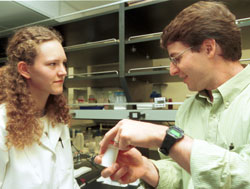
Dan Giammar, Ph.D., Washington University assistant professor of civil engineering, has been studying the chemical effects of injecting carbon dioxide into underground saltwater aquifers, layers of permeable rock, sand or gravel. Aquifers measure thousands of square miles and are located hundreds of feet underground, but Giammar can simulate their conditions in an area the size of your hand. A 23-cubic centimeter “batch reaction cell” gives data on what happens when carbon dioxide mixes with different kinds of rock. The information generated from his work could be incorporated into reactive transport models, mathematical simulations that predict behavior based on groundwater flow and chemical reactions.
“If you make more of it (carbon dioxide), you’re going to have to do something with it,” said Giammar. “Storing and sequestering is a good option.”
Giammar’s research may lead to not only storage but also permanent sequestration of carbon dioxide. He has found that when combined with silicate minerals containing either calcium, magnesium, or iron, carbon dioxide will precipitate, or change, into a carbonate solid.
“If you just have gaseous carbon dioxide stored underground, it becomes problematic when you think about leakage. But the carbonate mineral is a solid. It can’t leak.”
If carbon dioxide were injected into deep saline aquifers, several reactions would occur. The minerals would begin to dissolve as the pH of the saltwater became more acidic. The porosity of the rock would increase, allowing for the addition of more carbon dioxide. Eventually, carbonate solids would precipitate. This last phase is the most important in this model.
“Reactive transport models now make assumptions based on calculations that carbonates will precipitate at a certain time,” said Giammar. “If that ‘s not what is really happening in the environment, we should know that. If we can understand this process, potentially it could give us the ability to control when and where these minerals form.”
Carbon dioxide sequestration is still in its infancy. Giammar began his work on the project as part of the Carbon Mitigation Initiative at Princeton University. The United States Department of Energy (DOE) currently is planning a heavily monitored system to inject carbon dioxide into a sandstone aquifer on the Texas Gulf Coast. Another project in the North Sea has been storing carbon dioxide in an aquifer beneath the ocean for several years. And most recently, drilling began in July 2003 on a 10,000-foot well to evaluate underground rock layers in New Haven, W. Va.. as part of a DOE carbon sequestration research project now underway at the American Electric Power Mountaineer plant there.
Data on chemical reactions in sequestrations is hard to find, however, because the system is not well monitored.
“If we’re really going to do this in a responsible way, we have to know more about the overall behavior of a carbon dioxide storage system,” Giammar said.