


An international group of researchers, led by Fiona Marshall, Ph.D., professor of anthropology in Arts & Sciences, has found evidence for the earliest transport use of the donkey and the early phases of donkey domestication, suggesting the process of domestication may have been slower and less linear than previously thought.
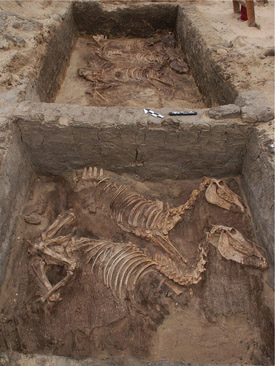
Based on a study of 10 donkey skeletons from three graves dedicated to donkeys in the funerary complex of one of the first Pharaohs at Abydos, Egypt, the team, led by Marshall and Stine Rossel of the University of Copenhagen, found that donkeys around 5,000 years ago were in an early phase of domestication. They looked like wild animals but displayed joint wear that showed that they were used as domestic animals.
“Genetic research has suggested African origins for the donkey,” said Marshall. “But coming up with an exact time and location for domestication is difficult because signs of early domestication can be hard to see. Our findings show that traces of human management can indicate domestication before skeletal or even genetic changes.”
The previously unpublished research was presented in “Domestication of the Donkey: New Data on Timing, Process and Indicators” in the March 10 online edition of the Proceedings of the National Academy of Sciences.
Domestication of the donkey from the African wild ass was a pivotal point in human history. It transformed ancient transport systems in Africa and Asia and the organization of early cities and pastoral societies.
The research team examined the 5,000-year-old Abydos skeletons along with 53 modern donkey and African wild ass skeletons. Analysis showed that the Abydos metacarpals were similar in overall proportions to those of wild ass, but individual measurements varied. Mid-shaft breadths resembled wild ass, but mid-shaft depths and distal breadths were intermediate between wild ass and domestic donkey.
Despite this, all the Abydos skeletons exhibited a range of wear and other pathologies on their bones consistent with load carrying. Morphological similarities to wild ass show that despite their use as beasts of burden, donkeys were still undergoing considerable phenotypic change during the early dynastic period in Egypt. This pattern is consistent with recent studies of other domestic animals that suggest that the process of domestication is slower and more complicated than had been previously thought.