


Researchers at Washington University in St. Louis and Arizona State University have sequenced the genome of a rare bacterium that harvests light energy by making an even rarer form of chlorophyll, chlorophyll d. Chlorophyll d absorbs “red edge,” near infrared, long wave length light that is invisible to the naked eye.
In so doing, the cyanobacterium Acaryochloris marina competes with virtually no other plant or bacterium in the world for sunlight. As a result, its genome is massive for a cyanobacterium, comprising 8.3 million base pairs. It is sophisticated, too. The genome is among the very largest of 55 cyanobacterial strains in the world sequenced thus far, and it is the first organism containing chlorophyll-d to be sequenced.
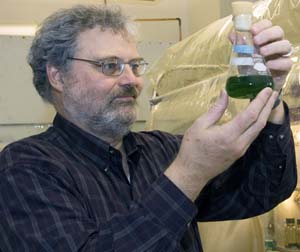
Robert Blankenship, Ph.D., the Lucille P. Markey Distinguished Professor in Arts & Sciences at Washington University and principal investigator of the project, said with Acaryochloris marina now sequenced and annotated, the immediate goal is to find the enzyme that causes a chemical structure change in chlorophyll d, distinguishing it from primarily chlorophyll a, and b, but also from nine other forms of chlorophyll.
“The synthesis of chlorophyll by an organism is complex, involving 17 different steps in all,” Blankenship said. “Some place near the end of this process an enzyme transforms a vinyl group to a formyl group to make chlorophyll d. This transformation of chemical forms is not known in any other chlorophyll molecules.”
Blankenship said he and his collaborators have some candidate genes they will test. They hope to insert these genes into an organism that makes just chlorophyll a. If the organism learns to synthesize chlorophyll d with one of the genes, the mystery of chlorophyll d synthesis will be solved, and then the excitement will begin.
Blankenship and his colleagues from both institutions published a paper on their work in the Feb. 4 online edition of the Proceedings of the National Academy of Sciences. The work was supported by the National Science Foundation and also involved collaborators from Australia and Japan. Three WUSTL undergraduate students and one graduate student participated in the project, as well as other research personnel.
Future applications
Harvesting solar power through plants or other organisms that would be genetically altered with the chlorophyll d gene could make them solar power factories that generate and store solar energy. Consider a seven-foot tall corn plant genetically tailored with the chlorophyll d gene to be expressed at the very base of the stalk. While the rest of the plant synthesized chlorophyll a, absorbing short wave light, the base is absorbing “red edge” light in the 710-nanometer range. Energy could be stored in the base without competing with any other part of the plant for photosynthesis, as the rest only makes chlorophyll a. Also, the altered corn using the chlorophyll d gene could become a super plant because of its enhanced ability to harness energy from the sun.
That model is similar to how Acaryochloris marina actually operates in the South Pacific, specifically Australia’s Great Barrier Reef. Discovered just 11 years ago, the cyanobacterium lives in a symbiotic relationship with a sponge-like marine animal popularly called a sea squirt. The Acaryochloris marina lives beneath the sea squirt, which is a marine animal that attaches to rocks just below the surface of the water. The cyanobacterium absorbs “red edge” light through the tissues of its pal the sea squirt.
Fat and happy
The genome, said Blankenship, is “…fat and happy. Acaryochloris marina lies down there using that far red light that no one else can use. The organism has never been under very strong selection pressure to be lean and mean like other bacteria are. It’s kind of in a sweet spot. Living in this environment is what allowed it to have such dramatic genome expansion.”
Blankenship said that once the gene that causes the late-step chemical transformation is found and inserted successfully into other plants or organisms, it could potentially represent a five percent increase in available light for organisms.
“We now have genetic information on a unique organism that makes this type of pigment that no other organism does,” Blankenship said. “We don’t know what all the genes do by any means. But we’ve just begun the analysis. When we find the chlorophyll d enzyme and then look into transferring it into other organisms, we’ll be working to extend the range of potentially useful photosynthesis radiation.”