


Videos have been the bailiwick of rock stars at least since the days of Bob Dylan. But now they’re spilling over into a new arena — academia.
Michael E. Wysession, Ph.D., associate professor of earth and planetary sciences in Arts & Sciences at Washington University in St. Louis, has 48 lectures on planet Earth coming out in video format in February. It’s a sort of brainiac’s boxed set. Each 30-minute lecture focuses on an aspect of the Earth, from its origins and composition to its climate, orbit, pollution and relationship to human history.
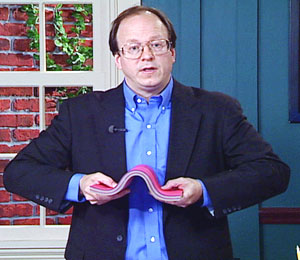
Wysession has also written a 250-page book to accompany the lectures. His audience includes schools and libraries but mostly consists of individual professional people — doctors, lawyers, engineers — who tend to seek knowledge in areas of their curiosity, but not of their expertise. A version of the course for home-schooled students is also in the works.
“The lectures are designed to give someone a full sense of the history of the Earth and how it works,” Wysession said. “To me, it’s a real mission to increase people’s understanding of the fundamental issues involved with the Earth, pollution, evolution, climate change and the environment. I hope they give a sense that people are also a big part of the story. We are not separate in watching things happen to the Earth. We, people, are now the Earth’s greatest agents of geologic change. We need to understand that power if we are to ever be able to use it responsibly. That’s the lesson I want people to take home with them.”
The Teaching Company, the leading maker of video college courses, produces “How the Earth Works”. Based in Chantilly, Va., the company not only looks for people who have stellar reputations in their fields, but who also are known to give entertaining, inspiring lectures.
Much of the material for the videos comes from a course, “Earth and the Environment,” that Wysession has co-taught at WUSTL for more than 15 years. The course is required for majors in earth and planetary sciences.
Wysession noted that several lectures are devoted to the theme of climate and humans and how geological events have played vital roles in shaping human history. He cited the example of a huge volcanic eruption in Tambora, Indonesia, in 1816 that filled the Earth’s skies with so much ash and aerosols that crops failed globally and the Earth turned colder for many years. This timeframe corresponded to the westward migration of people from the eastern United States in search of suitable places to grow crops.
While Wysession is an old pro at delivering lectures, he said that lecturing in a classroom and making these types of studio-based video lectures are two very different ways of getting the message out to the public. And he had an adjustment to make.
He made the lectures at the Teaching Company’s large studio in Chantilly, where he delivered up to three lectures per daily studio session.
“I was nervous at first,” he said. “I was in a room with lights and cameras but no people, and I had to look like I was relaxed and conversing with people. We had to re-do the first six lectures, but then I found my stride.
“It’s a real honor to do these for the public, and a pleasure to get the message out that the systems that control Earth, which include people like you and me, are all interconnected.”