


A team of researchers headed by an environmental engineer at Washington University in St. Louis is plying new techniques to produce a biofuel superior to ethanol.
The fuel is butanol; it can be derived from lignocellulosic materials, which are plant biomass parts that range from woody stems and straw to agricultural residues, corn fiber and husks, all containing in large part cellulose and some lignin.
Butanol is considered to be a better biofuel than ethanol because it’s less corrosive and has a higher caloric value, giving it a higher energy value. Like ethanol, butanol is being considered as an additive to gasoline.
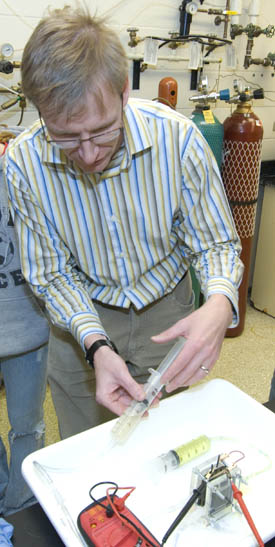
Lars Angenent, Ph.D., assistant professor of energy, environmental and chemical engineering, takes pre-treated corn fiber, a byproduct of corn-to-ethanol production, from his collaborators at the United States Department of Agricultural (USDA) research facility in Peoria, Ill., and places the lignocellulosic biomass into digesters comprised of a selected mixed culture of thousands of different microbes to convert the biomass into butyrate.
From there, the material is sent back to Peoria where another collaborator, Nasib Qureshi. Ph.D., converts the butyrate to butanol using fermenters.
The USDA researchers Bruce Dien, Ph.D., and Michael Cotta, Ph.D. use physical and chemical techniques to make the hard-to-degrade lignocellulosic material more amenable to degrade, an important step that allows Angenent’s mixed media culture to work its magic.
He uses a mixed culture containing thousands of different microorganisms and optimizes environmental conditions to select for a bacterial community that makes an environment conducive to the conversion of the corn fiber to butyrate.
Mixed culture magic
“The thrust of my lab is the use of mixed cultures,” said Angenent. “The advantage of mixed cultures is that it can take just about any waste material, and through our manipulations, convert it into something valuable. For instance, I can alter the pH in this culture. By keeping it neutral, I can get methane gas, but when I lower the pH, I can get butyrate. If I have a pure culture, on the other hand, I have to worry about other organisms slipping in and altering or contaminating the environment.
“Lignocellulosic biomass is plentiful, renewable and a good way to deal with wastes. By using it, we open the door for better economic opportunities for crop producers and rural communities. And because this kind of biomass is carbon-neutral, we don’t worry about carbon dioxide being released into the atmosphere.”
Using microbial fuel cells and his mixed media cultures, Angenent, in recent years, has produced electricity or hydrogen in the process of treating wastewater.
He is the principal investigator of a USDA grant for $425,000 for this research, along with his co-P.I.s from USDA.
The butanol bandwagon is growing. In 2006, chemical maker DuPont and the British oil company BP announced a collaboration with British Sugar to introduce butanol made from sugar beets as a gasoline-blending additive in the United Kingdom.