


Robert G. Kranz, Ph.D., professor of biology in Arts & Sciences at Washington University in St. Louis, has been awarded two grants from the National Institutes of Health (NIH) to study pathways in bioenergy conversion. The first, for $1,203,250, is a long-term NIH R01 renewal that began Aug. 1, titled “Cytochrome c Biogenesis.” The renewal award means that NIH has funded Kranz continuously for 22 years.
The U.S. Department of Agriculture, U.S. Department of Energy, National Science Foundation and Monsanto Co. also have supported the Kranz group during the past 20 years.
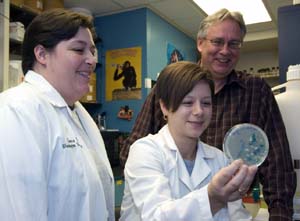
Cytochrome c is a protein with the heme cofactor covalently attached to it. Cytochrome c is crucial for energy production in many bacteria and higher organisms, including humans, and it is one of the most rigorously researched cellular components over the past 60 years. It is essential for the production of ATP (adenosine triphosphate), the compound that energizes all organisms.
The road the cell takes to make cytochrome c is called the biogenesis pathway. There are three different pathways that organisms use to assemble a c-type cytochrome, and in a 1998 review Kranz and colleagues termed these “systems I, II and III.”
Kranz discovered the most complex one, called system I, and began publishing the results in 1989, describing many of the genes required for the system I pathway.
Current members of the Kranz group include Cindy Richard-Fogal, Ph.D., research scientist in biology in Arts & Sciences, and graduate research assistant Elaine Frawley, who have engineered two of the three biogenesis pathways in E. coli.
Now they will engineer the third, which is naturally present in humans. Additionally the function and mechanisms behind each protein in the pathways will be studied.
The second NIH grant, an R21 award of $190,000, is to further develop a screen to find inhibitors of the pathways. Because bacteria have either system I or II but humans do not, inhibitors could be potential antimicrobial agents against certain infectious diseases.
Once the screens are developed, the Kranz group will collaborate with Lucile White, Ph.D., and Krister Wennerberg, Ph.D., at the Southern Research Institute in Birmingham, Ala., which is a center for NIH’s Roadmap for Medical Research Initiative on high throughput screening.
Importantly, the grant award provides access to the NIH Molecular Libraries Screening Center Network (MLSCN) and to experts like White and Wennerberg. The NIH “library” of chemicals is composed of 100,000 different small molecules.
Kranz always has taught undergraduates at Washington University. He taught microbiology to juniors and seniors for 14 years and freshman biology for four years.
Kranz currently is teaching a four-credit laboratory course in DNA manipulations that meets for eight hours on Friday and Saturday and one hour on Wednesday.
Toward a bacterial fuel cell
Two of the projects for the junior-senior-level class are related to bioenergy conversion, whereby the students are cloning and knocking out genes for many cytochromes.
These cytochromes are potentially involved in bioelectricity generation. This work also is linked to the biogenesis pathways and began as collaboration between the Kranz group and Lars Angenent, Ph.D., Washington University assistant professor of energy, environmental and chemical engineering.
Miriam Rosenbaum, Ph.D., a visiting research associate in the Angenent lab; Rachel Lee, a biomedical engineering undergraduate and Frawley from the Kranz group, are piloting these studies in their spare time.
The long-term goal is to engineer “electrical nanowires” into E. coli to make an efficient E. coli biofuel cell.
“We are the experts in genetic engineering of such nanowire proteins and they (the Angenent lab) are the microbial fuel cell experts, a perfect fit that has been a fun collaboration,” Kranz said.
“Once we have the preliminary data, our plan is to write up a joint grant on extending these efforts. The grant preparation and proposal also is intended to provide valuable experience for team members who are on track to become teachers and researchers,” Kranz said.
Kranz has five undergraduate students working in his research lab and takes pride in training them.
He said that by the time they graduate, the undergraduate students are as good as most advanced graduate students at designing, implementing and analyzing experiments.