


An ecologist at Washington University in St. Louis has discovered that after ponds dry up through drought in a region, when they revive, the community of species in each pond tends to be very similar to one another, like so many suburban houses made of ticky tacky.
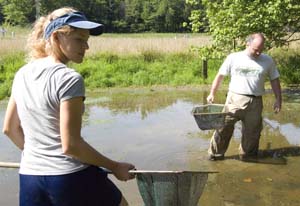
Jonathan M. Chase, WUSTL associate professor of biology in Arts & Sciences, and director of the university’s Tyson Research Center, created 20 artificial ponds out of tanks that hold 300 gallons of water. He made each pond community exactly the same in their environmental conditions, but varied the timing in which he added many species to the community — lots of species, especially dragonflies, water-bugs, frogs, and even algae, happily colonized the ponds on their own accord.
As the communities thrived, most of the ponds diverged from each other — some had only between 10 and 20 percent of species in common with other ponds. This factor was due to stochasticity, or randomness — a plant introduced by a seed dropped from a duck, a frog having a lucky day, for instance.
But then Chase, having played beneficent god, played pernicious god, adding drought, normally random in nature, to one-half of the pond environments.
“After the drought, the communities converged, and every community looked similar to each other,” said Chase, who studies community assembly, among other areas of ecology. “It’s understandable that only certain kinds of species can stand the drought. When it comes to drought, there are wimpy species and hardy species. Several types of zooplankton, many water-bugs, and some frogs are the hardy ones. A wimpy species, perhaps surprisingly, is the bullfrog. Their tadpoles require two years to grow, so they often don’t rebound very well from drought. ”
Some of the zooplankton have resting eggs that are deposited in mud. They rebound well when the ponds refill. Some frogs leave the pond when it dries up. Lots of different types of algae and one or two species of plant make it through, including one annual plant that makes lots of seeds, so when the pond refills again, it’s ready to flourish.
Go elsewhere, or die
These tough species are incumbents, which gives them an advantage when the ponds refill. They can rebuff some of the new colonists. Niches get filled in the pond and colonists trying to join the club either go elsewhere or die.
“Drought homogenizes the variance among communities,” Chase said. “It takes all these communities that used to be very different from each other and makes them very similar to each other. That’s a very much underappreciated part of biodiversity.”
Chase’s research was published in the Oct. 15 issue of Proceedings of the National Academy of Sciences. His work is funded by the National Science Foundation.
Chase’s findings are important to the study of biodiversity because he analyzed ponds both locally and regionally. A local analysis measures alpha diversity, which is the analysis of all the species in one pond. Chase, on the other hand, measured beta diversity, which measures the difference among ponds. If before the drought each pond had 10 species but only shared five in common, that difference is beta diversity.
“I found drought had less than a 10 percent reduction on local diversity, but a nearly 50 percent reduction on regional diversity. This is important because if you just count the number of species in any given pond you might say that drought had little effect on species diversity. But if you take exact data and you ask: Did drought affect regional diversity? I found it had a huge effect on regional diversity.”
Most diversity studies only have looked at local communities, which in many cases rebound very quickly following disturbances. Thus, ecologists trying to restore wetlands, prairies, or forests, could get the impression that all is needed is to “build it and they will come.” But Chase’s findings show that community assembly can sometimes be much more random than that.
Chase’s results have implications for wetland mitigation projects, which are often required by law. If a hundred acres of wetlands have been taken out by agriculture or a mall development, those one hundred wetland acres have to be created some place else. Ecologists are not sure exactly how to build functioning wetlands in the same way as the previous one, which had been assembled thousands of years ago. His findings give researchers better clues of how to go about restorations to restore biodiversity at both local and regional scales.
“I would argue that this has important implications for how to go about restoring and creating wetlands, and that in particular, we need to think about the role of stochasticity, leading to beta diversity among otherwise similar habitats, when we restore habitats.”