|
 |
Tip
Sheet: Science & Technology

Tip sheets highlight timely news and events at Washington University in St. Louis. For more information on any of the stories below or for assistance in arranging interviews, please see the contact information listed with each story. For comments on the Science & Technology news tips service, please contact the editor, Tony Fitzpatrick at (314) 935-5272 or tony_fitzpatrick@aismail.wustl.edu.
Tips Sheets: Business,
Law & Econ | Culture
& Living | Medical
Science & Health | Science & Technology
New Washington University center formed to protect nation

Media assistance:
Tony Fitzpatrick
- (314) 935-5272
Source: Ronald
Indeck's Web page
Source: Joseph
O'Sullivan's Web page
Source: Robert
Pless' Web page
Related: Record
profile on Ron Indeck

[St. Louis, Mo., September 2002]
- The
Center for Security Technologies (CST) at Washington University in
St. Louis has been founded to help address our country's need to protect
its people, infrastructures and information from threats to security.
 |
|
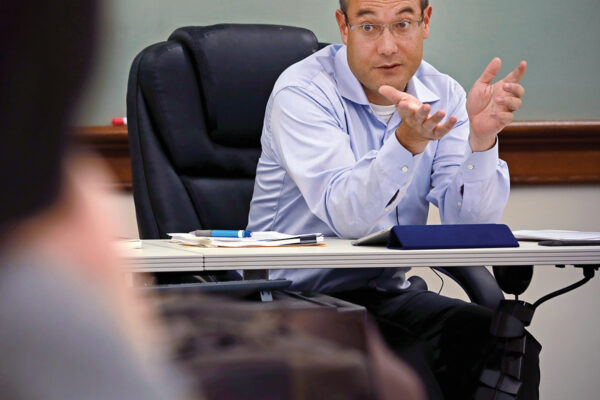
Principals of the Center for Security Technologies are, from left, Robert Pless, Ph.D., assistant professor of computer science, CST Assistant Director; Ronald S. Indeck, Ph.D., the Das Family Distinguished Professor of Electrical Engineering, CST director; and Joseph A. O'Sullivan, Ph.D., professor of electrical engineering, CST associate director. |
Such
threats come in various forms,
from natural disasters, to environmental
catastrophes, to terrorism.
Involving more than 30 faculty
members from a variety of disciplines,
the new center is focusing on
scientific and engineering aspects
of the development of advanced
security systems.
The CST's director is Ronald S.
Indeck, Ph.D., the Das Family
Distinguished Professor of Electrical
Engineering. Engineering faculty
from the Departments of Electrical
Engineering, Computer Science,
and Systems Science and Mathematics,
as well as the Center for the
Application of Information Technology,
are playing an active role in
the new center. University faculty
from the disciplines of chemistry,
earth and planetary science, political
science, law and social work also
are involved in CST.
"Security systems will continue
to become more sophisticated over
time, as will methods to defeat
them," Indeck said. "Our
new center provides the long-term
view that is necessary to anticipate
future threats and to make progress
in security system design and
development."
The CST is a natural extension
of research already in place at
the University. A partial list
of pertinent research projects
-- either completed or in progress
-- includes target recognition;
fingerprint and face recognition;
voice recognition; Internet security;
and improved methods for complex
searching of massive databases
for intelligence applications.
Research of CST participants already
has applicability to important
problems faced by individuals,
government and industry. Among
them are object verification and
recognition; data mining of massive
text and image databases; fraud
of credit cards, currency and
other objects ;and security, including
security of buildings and facilities,
of societal infrastructures, of
information and information systems,
and of communications.
Indeck pointed out that any system
designed to protect security in
our democratic society must face
up to the often conflicting needs
of privacy and security.
"We recognize that technology
raises important questions of
a legal and social nature,"
he said. "We are incorporating
issues of privacy and public policy
directly, early in the design
process, in an effort to achieve
seemingly contradictory goals
of security and privacy.
Indeck said researchers expect
to enable new industries with
their work and collaborate with
government and corporations on
security projects.
The center's members are confident
that the synergy created by combining
their talents and knowledge will
continue to lead to important
breakthroughs in security technologies.
"The Center for Security
Technologies is positioned to
be the foremost center focused
on security, Indeck said.
"We have enormous leverage
to become an exciting forum for
new ideas and collaboration.
The Center for Security Technologies
has organized its areas of strength
into these categories: sensors;
advanced electronic systems; signal
and image processing; recognition
theory and systems vision for
security; distributed and mobile
systems; network and information
security; l detection, isolation,
and accommodation of faults; and
law, economics and public policy.
For each of CST's thrusts, a team
of faculty experts has been assembled.
Under the guidance of a team leader,
each team will combine its talents
to work toward developing security
technologies in its specific area.
The areas of expertise are being
used in the following engineering
demonstration testbeds. All have
high-potential commercial value
to important security systems.
These areas are:

biometrics and physics-based
recognition systems;

network of video cameras;

fast searching of massive databases;

high-speed network security; and

security of the food and water
supply. |
|