Record current issue Presidential Debate
Gargoyle

  -  Faculty Experts


  -  News by Topic

  -  News by School


Search News & Info


WUSTL in the News
  - Powered by Google


WUSTL Home

Public Affairs Home

News
Releases

University News

Medical News

Sports News

Radio Service

Tip Sheets

Business, Law & Econ

Culture & Living

Science & Technology
Media Resources
Contact Information

TV/Radio Studio

Visiting Our Campuses

Campus Images

Sports photography
Commercial Filming
   and Photography


Commercial Use of
   Names and Symbols

Domain Name policy
WUSTL Information
Record (newspaper)

Campus Calendars

WUSTL News Summary

Publications Online

Facts, Guides & Maps


Tip Sheet: Business, Law & Economics

Tip sheets highlight timely news and events at Washington University in St. Louis. For more information on any of the stories below or for assistance in arranging interviews, please see the contact information listed with each story. For comments on the Business, Law & Economics news tips service, please contact the editor, Robert Batterson at (314) 935-5202 or batterson@olin.wustl.edu.

Tips Sheets: Business, Law & Econ | Culture & Living | Medical Science & Health | Science & Technology

Swinging from centralized to decentralized management keeps corporations functioning efficiently

Media assistance: Robert Batterson - (314) 935-5202
Source: Jack A. Nickerson's Web page - (314) 935-6374
Source: Todd R. Zenger's Web page - (314) 935-6399
Related: Download the PDF document: "Being Efficiently Fickle: A Dynamic Theory of Organizational Choice"
Related: Download the PDF document: Vascillation Figures 1-5

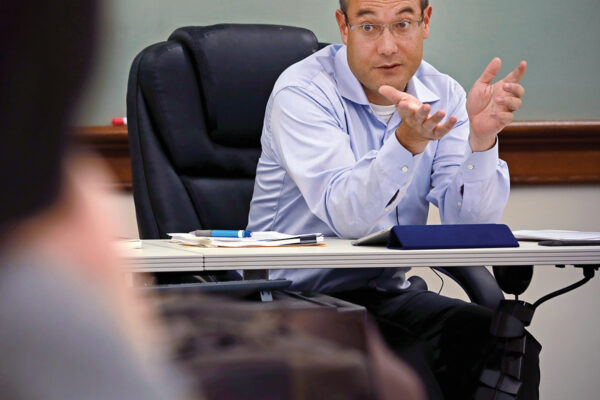
[St. Louis, Mo., May 2002] - The pendulum theory of business organization keeps corporations functioning efficiently, say two professors at the Olin School of Business at Washington University in St. Louis. They have developed a theory about why corporate management may switch back and forth between different organizational structures like swings of a pendulum. "Even though popular press publications often criticize managers for fickleness, pendulum swings, for instance from centralized to decentralized structure and back again, are good for business," says Associate Professor Jackson Nickerson who co-wrote a paper on the theory with Professor Todd Zenger, associate dean of faculty at Olin. Their paper will be published in the fall issue, vol. 13, of "Organization Science."

Hewlett-Packard's "pendulum swings" of centralized to decentralized management since 1980.

“We argue that the role of management is not to craft an optimal organizational structure, which in most instances is impossible. Instead, management's role is to recognize when and how frequently to switch the lever moving the company from one organizational structure to another," says Nickerson.

“Over the last century managers have talked about wanting organizational flexibility and innovation yet with control and coordination. We believe that it is impossible to design an organization that achieves all at once," Nickerson explained.

"With a decentralized organizational structure you can achieve flexibility and innovation and with a centralized organization you have control and coordination. You cannot design a single organizational structure that delivers both at the same time. However, we believe organizations can temporarily achieve both goals by switching back and forth like a pendulum between different organizational structures, which can be an efficient and good thing to do,” he says.

Jack Nickerson
Jack Nickerson
"Our theory is based on three ideas. First, most organizational choices are discrete. A firm can make or buy a component. A firm can centralize or decentralize an activity but not do both simultaneously. A firm can organize by industry focus, functionally, or geographically but typically can't do all three at once. Each choice is a set of formal incentives and policies that are vastly different from each other and cannot be blended.

“Second, the way in which work actually gets done changes slowly in response to any change in the formal organization. Managers can choose a formal policy but work really gets done through the informal organizational structure stemming from social relationships and routines," Nickerson points out.

Although this informal structure reconfigures in response to a new formal structure, social relationships and routines change slowly. Rather than this inertia being bad, Nickerson and Zenger argue that inertia actually benefits the organization because it allows for a temporary blending of the old and the new organizational structure. Just as a pendulum momentarily passes through the nadir as it traverses from one side of its swing to the other, so too can organizations momentarily provide both flexibility and coordination as the informal organization reconfigures from one set of formal policies to another. Then, everything clicks.

Todd Zenger
Todd Zenger
“For a short time, the company can be all things -- innovative and flexible yet controlled and coordinated," Nickerson and Zenger say. "Of course, after a while, things get worse as the pendulum gets further and further away from the nadir. However, this is when management switches back to the prior formal structure and directs the informal structure to head back toward the nadir."

Finally, Nickerson and Zenger caution that changing an organization is a costly and risky endeavor. They suggest that ultimately, switching back and forth may not be appropriate if the costs of change are great or if the benefit from temporarily blending different organizational structures is low.

A prime example is Hewlett-Packard, say Nickerson and Zenger. In the 1970s, the company was decentralized with a lot of small divisions. Then along came the technological explosion with PCs. By the early 1980s, three divisions of H-P were working on desktop computers, none of which were compatible with each other. So, H-P centralized all the computer divisions, which led to a system that was coordinating compatible computers. But that system eroded into a bureaucracy, which drove out innovation and talent.

In 1990, H-P management switched back to a decentralized organizational structure that created a path for more creativity but poor coordination. In 1994, H-P switched back to a centralized structure, then, in 1998, swung back to a decentralized system, and in 2000, back to centralized. "Ford Motor Co. has similarly vacillated about every five years since 1980," Nickerson adds. "The decision for management is not if to switch but when and how frequently and how many divisions or the entire company," Nickerson says.


News & Information Home  |   Office of Public Affairs  |   WUSTL Home

Please contact us and let us know how we can assist you.
Technical problems with this Web site? Please contact news_bugs@aismail.wustl.edu.
Please review the WUSTL News & Information copyright/privacy policy.