Record current issueFlag at half staff

Gargoyle

  -  Faculty Experts


  -  News by Topic

  -  News by School


Search News & Info


WUSTL in the News
  - Powered by Google


WUSTL Home

Public Affairs Home

News
Releases

University News

Medical News

Sports News

Radio Service

Tip Sheets

Business, Law & Econ

Culture & Living

Science & Technology
Media Resources
Contact Information

TV/Radio Studio

Visiting Our Campuses

Campus Images

Sports photography
Commercial Filming
   and Photography


Commercial Use of
   Names and Symbols

Domain Name policy
WUSTL Information
Record (newspaper)

Campus Calendars

WUSTL News Summary

Publications Online

Facts, Guides & Maps


Washington University in St. Louis News & Information > Faculty Experts at Washington University in St. Louis >

Carl M. Bender

The Wilfred R. and Ann Lee Konneker Distinguished Professor of Physics in Arts & Sciences
  • The Wilfred R. and Ann Lee Konneker Distinguished Professor of Physics in Arts & Sciences, Physics

Expertise: quantum mechanics, quantum field theory, black holes, global warming, Star Wars, debunking scientific myths, theoretical physics

Bio:
Carl Bender
Carl Bender
Download
Carl M. Bender, a professor of physics in Arts & Sciences, is a frequent speaker to area groups as well as at scientific conferences around the world because he excels in communicating to colleagues, future scientists and the general public. "He is absolutely amazing in his ability to explain very complex and mathematical material in a crystal-clear manner," said G.S. Guralnik, Ph.D., of Brown University. "There is no one who approaches Carl in communication ability." Bender's topics include black holes, global warming and Star Wars. Reputed to be the world's leading expert in lower-dimensional quantum field theories, Bender has defined this area of research, in which he has made seminal contributions to all areas of particle theory. He co-authored Advanced Mathematical Methods for Scientists and Engineers: Asymptotic Methods and Perturbation Theory, which, according to J. Ely Shrauner, Ph.D., Washington University professor emeritus of physics, is "a classic book on mathematical physics that virtually every physicist, engineer and mathematician in the world has studied."

WUSTL Contact Information:
Work:(314) 935-6216
Fax:(314) 935-6219
E-mail:cmb@wuphys.wustl.edu
Address:Campus Box 1105
One Brookings Drive
St. Louis, MO 63130

Education:
  • Ph.D. in Physics at Harvard University
  • M.A. in Physics at Harvard University
  • A.B. in Physics at Cornell University


News Stories & Tip Sheets:

Showing 1 Stories.
Shake it up

For nonlinear systems, chaos leads to order

April 3, 2006 -- "Da police are not here to create disorder; dere here to preserve disorder." — Richard J. Daley, Chicago mayor, explaining to the media the role of the police during the riotous 1968 Democratic National Convention.

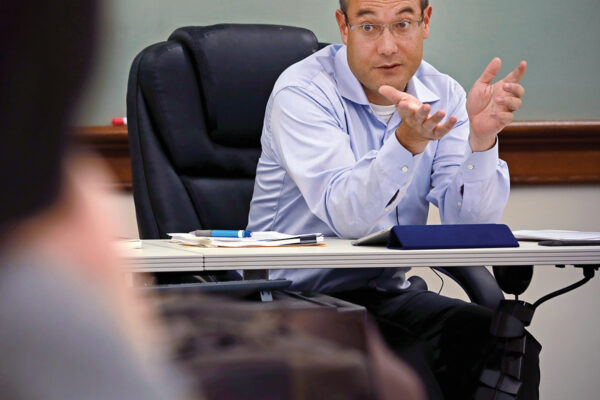
The order team.
David Kilper/WUSTL Photo
The order team.
Police keep order. That's why, for example, they issue tickets for "disturbing the peace." Thus the only logical conclusion to Mayor Daley's famous quote above — other than dismissing it as the result of a tangled tongue — is sometimes disorder spawns order. Sounds impossible, right? Wrong. According to a computational study conducted by a group of physicists at Washington University in St. Louis, one may create order by introducing disorder. More...


Showing 1 Stories.

Additional Background: Professor Bender's scholarly expertise is in mathematical physics and applied mathematics. Since the publication with S. Orszag of his book, Advanced Mathematical Methods for Scientists and Engineers, he has been regarded as an expert on the subject of asymptotic analysis and perturbative methods. He has devoted his professional academic career to using the methods of classical applied mathematics (asymptotics, perturbation theory, approximate methods, differential equations, combinatorics) to solve a broad range of problems in high-energy theoretical and mathematical physics.

His most important work is in the areas of lattice approximations in quantum field theory; semi-classical, strong-coupling, and mean-field approximations in quantum field theory; path integral representations; the nature of perturbation theory in large order; and, most recently, new kinds of nonperturbative techniques for quantum field theory. Because of his strong background in applied mathematics, he is able to enter quickly into fruitful research collaborations with a wide variety of scientists, whose interests range from applied to theoretical.

Bender, who was awarded a fellowship from the John Simon Guggenheim Memorial Foundation, was on sabbatical at Imperial College in London for his fellowship period, which ran from June 2003 to May 2004. There he conducted a research project titled "A New Approach to Quantum Field Theory."

Of the 184 Guggenheim fellowships awarded that year, only four were given in the area of physics.

Bender works primarily in quantum mechanics, the physics of very small, submicroscopic or atomic particles, and in particle physics and quantum field theory. Quantum mechanics underlies nearly all modern science and technology; it governs the essential components of computers and televisions and serves as a basis for chemistry.

In London, Bender worked on a new area of theoretical physics that he originated four years prior, namely, the extension of conventional quantum mechanics and quantum field theory into the complex plane.

"Complex quantum mechanics is not just a mathematical breakthrough," Bender said. "I believe it to be a major advance in the basic theory of quantum mechanics.

"The potential for research in this area is immense: Complex quantum mechanics provides a framework for describing the nature of antiparticles. It offers the possibility that a particle and its corresponding antiparticle need not have identical masses, and thus it may provide insight into the puzzle of why there is so much more matter than antimatter in the universe.

"Moreover, complex quantum mechanics gives a setting for exploring the physics of the Higgs particle, which is the as-yet unobserved and most poorly understood component of modern particle physics," Bender added.

Bender was invited to lecture on his work at more than a dozen universities in Europe during his fellowship year. He also presented invited talks at many international conferences on theoretical physics, including giving the keynote address at a conference in Prague, Czech Republic, that was devoted entirely to the field of complex quantum mechanics that he originated.

A Phi Beta Kappa, Bender earned a bachelor's degree, summa cum laude, in physics from Cornell University in 1964 and both a master's (1965) and doctorate (1969) in physics from Harvard University. After seven years on the Massachusetts Institute of Technology faculty, he joined Washington University's Department of Physics in 1977.

He was installed as the Wilfred R. and Ann Lee Konneker Distinguished Professor of Physics in Arts & Sciences at Washington University on Nov. 27, 2007.


Related Information
Media Assistance:

Diana Lutz
Senior Science Editor
dlutz@wustl.edu

(314) 935-5272
Related Links:
Record profile on Bender
St. Louis Science Academy award

Related Groups:

Departments:
Physics

- View All Groups

Related Topics:
Physics

- View All Topics

Revised:

Thursday, Nov. 5, 2009


  Email this page

  Print ready page


News & Information  |   Medical News  |   Office of Public Affairs  |   WUSTL Home

Please contact us and let us know how we can assist you.
Technical problems with this Web site? Email questions or comments.
Please review the WUSTL News & Information copyright/privacy policy.