|
|  |
Washington University in St. Louis News & Information > Faculty Experts at Washington University in St. Louis >

Professor of Anthropology in Arts & Sciences
Expertise: Costa Rica, Guyana, Madagascar, Mauritius, behavior and evolution, conservation, early models, human behavior, lemurs, primate ecology
Bio:
 |
| Sussman |
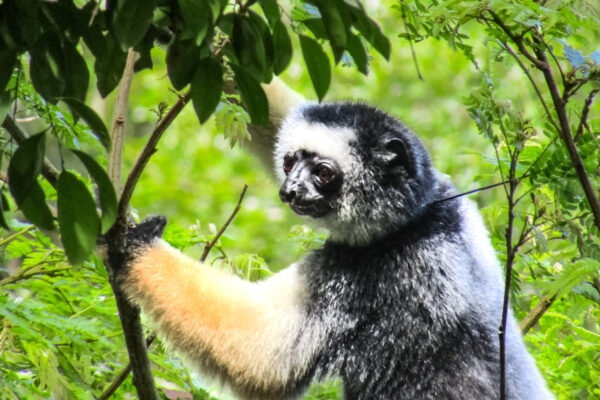
Sussman, a specialist in the ecology and social structure of primates, does extensive fieldwork in primate behavior and ecology in Costa Rica, Guyana, Madagascar and Mauritius. His groundbreaking study of two species was the subject of Marlin Perkins' documentary "Lemurs of Madagascar" in 1981. His research focuses on primate populations and threats to their habitats, including deforestation. Sussman is conducting a long-term study of the ring-tailed lemur's demography, ecology and social organization in Madagascar's Beza Mahafaly Reserve, which he co-founded. He is co-author of "Man the Hunted" (2005), for which he won a 2006 W.W. Howells Book Prize.
WUSTL Contact Information:
| Work: | (314) 935-5264 |
| Fax: | (314) 935-8535 |
|
|
Education:
-
Ph.D. in Anthropology at Duke University
-
M.A. in Anthropology at University of California at Los Angeles
-
B.A. in Anthropology at University of California at Los Angeles

| News Stories & Tip Sheets: |
Showing 4 Stories.
|
 |
Friendly apes
 Primates evolved to be social, not aggressive Sussman tells AAAS

Feb. 16,
2009 --
 |
| Sussman |
Primates are social animals. But why did they become social and what are the causes for the differences in social structure among various primate species? Robert W. Sussman, Ph.D., professor of anthropology in Arts & Sciences, addressed those questions and more in his talk "A Comparative Overview of Primate Social Organization" during the 2009 annual meeting of the American Association for the Advancement of Science Feb. 15 in Chicago.

|
Altruistic animals
 Major interdisciplinary conference to focus on the evolution of cooperation, altruism and sociality in primates and humans

Feb. 13,
2009 --
 |
| Wild baboons in Africa forage for food. |
Download
|
To watch the 5 o'clock news every night, you'd think man was born to be destructive, violent and antagonistic. But that's just not the case, argue numerous prominent researchers who will gather at Washington University in St. Louis March 12-14 to discuss the nature of human sociality. The conference, titled "Man the Hunted: The Origin and Nature of Human Sociality, Altruism and Well-Being," will be the first of its kind to include academics from around the world and across multiple disciplines — anthropology, psychiatry, human evolution, biology, religion, education and medicine — to focus on the evolution of cooperation, altruism and sociality and possible factors that led to the evolution of these characteristics in primates and humans.

|
Saving the lemur
 New satellite imaging research could save the lemur in Madagascar

March 3,
2008 --
 |
| Lemur population has declined sharply since the 1950s. Through education and conservation, a WUSTL expert hopes the trend will be reversed. |
Using satellite imagery, GIS and ecological and demographic data from the field, Robert W. Sussman, Ph.D., professor of anthropology in Arts & Sciences at Washington University in St. Louis, has studied the effects of deforestation on the ringtailed lemur population in Madagascar during the last forty years. He has determined that while causes of deforestation vary in different parts of the African island nation, the total lemur population has dropped by more than half since the 1950s.

|
It's natural to be nice
 Survival of the fittest? Anthropologist suggests the nicest prevail ? not just the selfish

June 9,
2004 --
Are humans inherently good? The prevailing view in popular and scientific literature is that humans and animals are genetically driven to compete for survival, thus making all social interaction inherently selfish. According to this line of reasoning, known as sociobiology, even seemingly unselfish acts of altruism merely represent a species' strategy to survive and preserve its genes. But Robert W. Sussman, Ph.D., a professor of anthropology in Arts & Sciences at Washington University in St. Louis, argues that this is a narrow and simplistic view of evolutionary theory that fails to explain many aspects of sociality among mammals in general and primates in particular. In "The Origins and Nature of Sociality," a new book Sussman co-edited, he and other researchers challenge the proponents of sociobiology. "The 'selfish gene' hypothesis is inadequate," Sussman says.

|
Showing 4 Stories.
|
 |
| Clips: |
Showing 3 Clips.
|
 |
Modern life's pressures may be hastening human evolution
Miami Herald online
and 23 others

April 13,
2009 -- Even today, scientists say that human beings are continuing to evolve as our genes respond to rapid changes in the world around us. WUSTL anthropology professor Robert Sussman comments.

|
Early Humans Were Prey, Not Predators, Experts Say
National Geographic News online
and 19 others

March 8,
2006 -- News story looks at the debate over whether early humans were predators or prey.
WUSTL anthropologist Robert Sussman is co-author of a book that presents a new theory that is part of a movement to debunk a long-running scientific bias that early humans were warlike.
The researchers presented their theories in February at the American Association for the Advancement of Science annual meeting in St. Louis.

|
Theory men are wired to kill straying mates is offensive and wrong
Wall Street Journal

May 20,
2005 -- WSJ science writer Sharon Begley critiques U. Texas professor David Buss' new book in which he explains how men's minds got wired to kill mates who strayed. She says, as evolutionary theory, this is ludicrous.
The claim that men are wired to kill their mate also flies in the face of fossil and primate data showing that early humans were prey, not predators, notes WUSTL anthropologist Robert Sussman, who is the co-author of Man the Hunted.

|
Additional Background: Sussman's research covers a wide array of topics in primatology, much of which is field-oriented and interdisciplinary. In Madagascar, he is conducting a long-term study of the demography, ecology and social organization of the ring-tailed lemur at the Beza Mahafaly Reserve. He is co-founder of this reserve, which is part of a cooperative program in research, conservation, education and development. He has worked with botanists, geologists and social anthropologists on this and other conversation/development projects. Currently they also are attempting to monitor deforestation in the southwest of Madagascar with satellite images and to determine its causes. This project is sponsored and supported in part by the St. Louis Zoo.In Costa Rica, he plans to develop a project, with bird and bat specialists, to study ecological interactions between frugivores at the La Selva Reserve. This reserve is operated by the Organization of Tropical Studies (OTS) -- a consortium of universities, including Washington University -- and is one of the best-studied tropical forest reserves in the world. He serves on the board of directors of OTS.
He recently began surveying forests of Guyana. With colleagues from Washington University, he hopes to develop a reserve similar to the one in Madagascar and to begin research in primate communities in Guyana.
His students have worked in many areas of the world and are not limited to areas in which he does research.
Sussman has published more than 100 articles in scholarly journals, including Science, and has written or edited seven books. His two most recent books are part of a three-volume reference-and-textbook set titled Primate Ecology and Social Structure (one on prosimians, the second on New World monkeys and the third on Old World monkeys and apes). After the third volume is completed, the trio will be published as a single volume on free-ranging primates.
He has received grants from the National Science Foundation, National Institutes of Health, National Geographic Society, World Wildlife Fund and the Fulbright Scholar Program, and a number of other agencies.
In 2001 he was named a fellow of the American Association of the Advancement of Science (AAAS), the highest recognition the organization bestows. He was also elected a council delegate from the AAAS's Section on Anthropology.
Sussman served a four-year term as editor in chief of American Anthropologist, the flagship journal of the American Anthropological Association. He prepared the journal's historic 100th anniversary issue in 1998, which focused on race and racism. He believes that anthropologists, as cross-cultural experts in human behavior and evolution, can play a major role in addressing current racial divisiveness.
Sussman earned bachelor's (1965) and master's (1967) degrees in anthropology from the University of California-Los Angeles and graduated with a Ph.D. from Duke University in 1972.
Courses
Primate Ecology and Behavior, Biological Basis of Human Behavior, Field Methodology, Behavioral Studies at the St. Louis Zoo, Selected Topics in Primatology
Selected Publications
Sussman, R.W., J. Cheverud, and T.Q. Bartlett
1995 Infant killing as an evolutionary strategy: reality or myth? Evolutionary Anthropology 3:149-151.
Sussman, R.W. and J. Phillips-Conroy
1995 A survey of the distribution and density of the primates in Guyana. International Journal of Primatology 16: 761-791.
Sussman, R.W., G.M. Green, and L.K. Sussman
1996 The use of satellite imagery and anthropology to assess the causes of deforestation in Madagascar. pp. 296-315, In L.E. Sponsel, T.N. Headland, and R.C. Bailey (eds), Tropical Deforestation: The Human Dimension. Columbia University Press, New York.
Norconk, M.A., R.W. Sussman, J. Phillips-Conroy
1996 Primates of Guyana shield forests. pp. 69-83. In M.A. Norconk, A.L. Rosenberger, and P. Garber (eds.). Adaptive Radiations of Neotropical Primates Plenum Press, New York.
Tattersall, I. and R.W. Sussman
1998 Little brown lemurs of northern Madagascar: phylogeny and ecological role in resource partitioning. Folia Primatologica 69: 379-388.
Sussman, R.W.
1997 The Biological Basis of Human Behavior. Simon and Schuster Custom Publishing, Nashville. (Editor)
1999 The myth of Man the Hunter, Man the Killer, and the evolution of human morality. Zygon: Journal of Religion and Science. 34: 453-471.
2000 Primate Ecology and Social Structure, Vol. 2: New World Monkeys. Pearson Custom Publishing, Boston, MA.
2000 Piltdown Man: The father of American field primatology. Pp. 85-103. In S.C. Strum and L.M. Fedigan (eds.) Primate Encounters: Models of Science, Gender and Society. University of Chicago Press, Chicago.
|
|  |
|