


Windows shape and frame, both literally and figuratively, the ways we see the world around us. Interfaces represent the points of contact between different systems, spaces and entities — for example, the screen, the mouse or the keyboard that connects the computer with the human user.
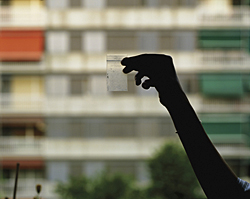
In August, the Mildred Lane Kemper Art Museum at Washington University in St. Louis will present Window | Interface, the second installment in its series Screen Arts and New Media Aesthetics. The exhibition will highlight a variety of artistic projects — including videos, photographs and digital installations — that explore the roles of windows and interfaces as both boundaries and sites of transaction between machine and mind, data and perception, the world of the body and the world of the imagination.
Drawn from private collections and major museums, Window | Interface is organized by Sabine Eckmann, Ph.D., director and chief curator of the Kemper Art Museum, and Lutz Koepnick, Ph.D., curator for new media as well as professor of German and Film & Media Studies in Arts & Sciences.
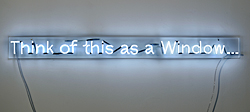
The first section of the exhibition explores the ways in which artists such as Doug Aitken, Cerith Wyn Evans, David Hilliard and Jeff Wall have used windows to represent abstracted, disembodied and framed sight. For example, Evans’s Think of this as a Window (2005) consists of cool neon letters spelling out the title on a horizontal, window-like sheet of plexiglass. The piece highlights the role of architectural windows as mechanisms for framing space and sight while also alluding to the range of framing and display devices we have come to experience as windows today, electronic or not.
Conversely, Jeff Wall’s Blind Window series (2000) posits a kind of dysfunctional window that seems to deny the very act of seeing. Displayed in backlit boxes, these three large-scale transparencies depict sites in which dilapidated window frames are barricaded or encased by rough wooden planks. At once formally elegant and claustrophobic, these scenes renegotiate the long tradition of associating the window with transparency and realism, thus “opening our view” to the different types of framed viewing explored throughout the exhibition.
The second section looks at ways in which multimedia installations, videos and photographs offer new aesthetic experiences with the help of electronic screens and interfaces. These works, by artists such as Joseph Beuys, Peter Campus, Olafur Eliasson, Iñigo Manglano-Ovalle, and Jeffrey Shaw, frequently move beyond visual experience to involve other senses, including hearing, touch and physical movement, thus underscoring the significance of the body as central to aesthetic experience.
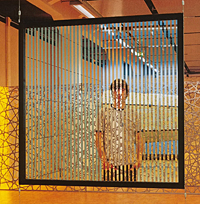
For example, Eliasson’s Seeing Yourself Seeing (2001) draws attention to the viewer’s own body and its role in framing visual experience. The work consists of a large sheet of glass, suspended from the ceiling, upon which mirrored elements have been applied in thin vertical strips. Viewers — peering through their own reflections and into the space beyond — are thus recast as active participants, creating a kind of fragmented double-image that shifts and changes with their every movement.
Other works, such as Manglano-Ovalle’s Le Baiser (The Kiss) (1999), investigate the relationship between the window, the body and contemporary media. This room-sized video installation consists of an imposing double-sided aluminum-frame screen that mimics the glass walls of Ludwig Mies van der Rohe’s iconic Farnsworth House. A multi-track film depicts two figures — a window washer (played by the artist) and a young woman wearing earphones — who, despite their physical proximity, seem to occupy different worlds, isolated from one another as well as from the external viewer.
The exhibition also includes a series of groundbreaking video works from the late 1960s and early 1970s. Campus’ Prototype for Interface (1972) consists of a glass sheet upon which the viewer’s image is both reflected and broadcast. TV Cello Premiere (1971) — a collaboration between Naim June Paik, Jud Yalkut and Charlotte Moorman — depicts Moorman, a Julliard-trained musician and Fluxus artist, in her first performance on Paik’s “TV cello.” Also on view will be Beuys’ Filz TV (Felt TV) (1970), in which the artist interacts with a felt-covered television screen; and Valie Export’s provocative Touch Cinema (1968), a videotaped performance in which passers-by were invited to reach inside a miniature “theater” concealing Export’s naked chest.
The Screen Arts and New Media Aesthetics series is designed to stimulate discussion about the aesthetics of the digital and its role in contemporary research, discourse and artistic practice. The series highlights emerging electronic forms as well as older forms of technological art such as photography, film and video through publications, exhibitions, lectures, workshops and discussions.
THE MILDRED LANE KEMPER ART MUSEUM
The Mildred Lane Kemper Art Museum, part of Washington University’s Sam Fox School of Design & Visual Arts, is committed to furthering critical thinking and visual literacy through a vital program of exhibitions, publications and accompanying events. The museum dates back to 1881, making it the oldest art museum west of the Mississippi River. Today it boasts one of the finest university collections in the United States.
Window | Interface will open Friday, August 31, and remain on view through Nov. 5. A panel discussion will take place at 6 p.m. Aug. 31 in Steinberg Hall and will be immediately followed by a public reception from 7 to 10 p.m. in the Mildred Lane Kemper Art Museum. The discussion, reception and exhibition are all free and open to the public. The Kemper Art Museum is located at the intersection of Skinker and Forsyth boulevards. Steinberg Hall is located immediately adjacent. Regular hours are 11 a.m. to 6 p.m. Mondays, Wednesdays and Thursdays; 11 a.m. to 8 p.m. Fridays; and 11 a.m. to 6 p.m. Saturdays and Sundays. The museum is closed Tuesdays.
For more information, call (314) 935-4523 or visit kemperartmuseum.wustl.edu.
|
WHO: Mildred Lane Kemper Art Museum WHAT: Exhibition, Window | Interface WHEN: Aug. 31 to Nov. 5. Opening reception 7 to 10 p.m. Friday, Aug. 31, following a panel discussion at 6 p.m. WHERE: Mildred Lane Kemper Art Museum, Washington University in St. Louis, near the intersection of Forsyth and Skinker boulevards. HOURS: 11 a.m. to 6 p.m. Monday, Wednesday and Thursdays; 11 a.m. to 8 p.m. Fridays; 11 a.m. to 6 p.m. Saturdays and Sundays. Closed Tuesdays. COST: Free and open to the public. INFORMATION: (314) 935-4523 or kemperartmuseum@wustl.edu |