


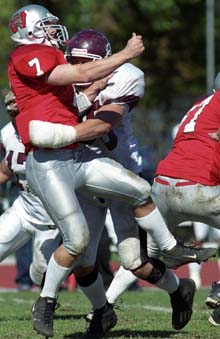
It’s a scene football fans will see over and over during the bowl and NFL playoff seasons: a player, often the quarterback, being slammed to the ground and hitting the back of his head on the landing.
Sure, it hurts, but what happens to the inside of the skull? Researchers and doctors long have relied upon crude approximations made from test dummy crashes or mathematical models that infer — rather loosely — what happens to the brain during traumatic brain injury or concussion.
But the truth is that the state of the art in understanding brain deformation after impact is rather crude and uncertain because such methods don’t give any true picture of what happens.
Now, mechanical engineers at Washington University in St. Louis and a neurosurgeon resident at the University’s Barnes-Jewish Hospital have devised a technique on humans that for the first time shows just what the brain does when the skull accelerates.
What they’ve done is use a technique originally developed to measure cardiac deformation to image deformation in human subjects during repeated mild head decelerations. Picture, if you will, a mangled quarterback’s occipital bone banging the ground, then rebounding. The researchers have mimicked that very motion with humans on a far milder, gentler, smaller scale and captured the movement inside the brain by magnetic resonance imaging (MRI).
Philip Bayly, Ph.D., Lilyan and E. Lisle Hughes Professor in Engineering, Guy Genin, Ph.D., assistant professor of mechanical engineering, and Eric Leuthardt, MD, formerly a resident at Barnes-Jewish Hospital, now at the University of Washington, tested seven subjects in an MRI and gathered data that show that the brain, connected to the skull by numerous vessels, membranes and nerves at the base, tries to pull away from all those attachments, leading to a significant deformation of the front of the brain.
Bayly discussed the group’s findings Nov. 10, 2005, at the annual meeting of the National Neurotrauma Society in Washington, DC.
According to Genin, the subjects are placed in the soft netting of a head guide, and are asked to raise and lower their heads about an inch inside an MRI machine. The process is repeated several times as the MRI pieces together a complete movie of the brain’s response to these skull motions.
“Phil (Bayly) has developed a set of state-of-the-art hardware and software to synchronize and analyze all of these measurements,” said Genin. “The systems he has developed will allow us to explore a broad range of questions critical to understanding mild traumatic brain injury.”
“It’s an interesting thing that in many occipital impact injuries, people often find the greatest injury in the front of the brain,” Bayly said. “That has been a puzzle for a long time and there have been numerous different explanations for it. What we see with the MRI is quite a bit of mechanical deformation in the front of the brain when the skull is hit from the rear. It seems to be because the brain is trying to pull away from some constraints in the front of the brain.”
Taking the guesswork out
Bayly and his collaborators can apply the levels of deformation they have found with their subjects to in vitro experiments or to animal models to learn even more about brain matter deformation. They have done experiments on humans with the head dropping forward, and plan to study different acceleration profiles, including rotations. “This method is a starting point that we hope will take the guesswork out of brain matter deformation analysis,” Bayly said. “We can now quantify brain deformation from these very low, mild accelerations with MRI. We are working with Washington University School of Medicine faculty in hopes of some day developing therapeutic remedies for traumatic brain injuries and concussions.
“The most immediate application of our data will be in the development and validation of computer simulations of traumatic brain injury, which may ultimately reduce the need for direct experimentation.”
Bayly and Genin are collaborating with David Brody, MD, Ph.D., instructor in neurology at the Washington University School of Medicine, and Sheng K. Song, Ph.D., assistant professor of radiology, on other advanced MRI techniques with the hope of finding noninvasive ways to detect and characterize brain injuries.