
Record current issueDebate 08

Gargoyle

  -  Faculty Experts


  -  News by Topic

  -  News by School


Search News & Info


WUSTL in the News
  - Powered by Google


WUSTL Home

Public Affairs Home

News
Releases

University News

Medical News

Sports News

Radio Service

Tip Sheets

Business, Law & Econ

Culture & Living

Science & Technology
Media Resources
Contact Information

TV/Radio Studio

Visiting Our Campuses

Campus Images

Sports photography
Commercial Filming
   and Photography


Commercial Use of
   Names and Symbols

Domain Name policy
WUSTL Information
Record (newspaper)

Campus Calendars

WUSTL News Summary

Publications Online

Facts, Guides & Maps


Washington University in St. Louis News & Information > University News >

Protective footwear started nearly 30,000 years ago, research finds

By Neil Schoenherr

Aug. 17, 2005 -- Those high-tech, air-filled, light-as-a-feather sneakers on your feet are a far cry from the leather slabs our ancestors wore for protection and support.
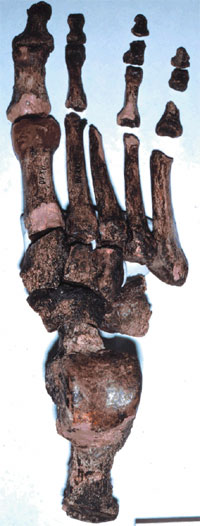
A 26,000 year-old early modern human showing the reduced strength of the bones of the lesser toes.
Erik Trinkaus / Czech Academy of Sciences
A 26,000 year-old early modern human, DolniVestonice 16 from the Czech Republic, showing the reduced strength of the bones of the lesser toes. It is one of three partial foot skeletons from Dolni Vestonice that shows the reduced lesser toe strength, all dating to about 26,000 years ago.
Download

But believe it or not, our modern day Nikes and Reeboks are direct descendents of the first supportive footwear that new research suggests came into use in western Eurasia between 26,000 and 30,000 years ago.

Erik Trinkaus, Ph.D., the Mary Tileston Hemenway Professor of Physical Anthropology, derived those dates by analyzing anatomical evidence of early modern humans, which suggests a reduction in the strength of the smaller toes in Upper Paleolithic humans while there was little change in leg strength.

His research was published in the July issue of the Journal of Archaeological Science.

Trinkaus argues that early humans living in far northern climates began to put insulation on their feet around 500,000 years ago. While archaeological evidence suggests that protective footwear was in use by at least the middle Upper Paleolithic in portions of Europe, the frequency of use and the actual mechanical protection provided by that footwear was unclear.

Use of protective footwear has been difficult to document because in most cases the footwear does not survive the test of time.

Lacking such physical evidence, Trinkaus analyzed the foot bones of western Eurasian Middle Paleolithic and middle Upper Paleolithic humans. In doing so, he found the anatomy of their feet began to change starting around 26,000 years ago.

"I discovered that the bones of the little toes of humans from that time frame were much less strongly built than those of their ancestors while their leg bones remained large and strong," Trinkaus said. "The most logical cause would be the introduction of supportive footwear."

During barefoot walking, the smaller toes flex for traction, keeping the toe bones strong. Supportive footwear lessens the roll of the little toes, thus weakening them.

Trinkaus' research paper is available here.


Related Information
Media Assistance:

Neil Schoenherr
News Writer; Assoc. Record Editor
nschoenherr@wustl.edu

(314) 935-5235
Subject Matter Experts:

Related Links:
Trinkaus' Web page
Journal of Archaeological Science article

Related Groups:

Departments:
Anthropology
History

Programs:
Archaeology

- View All Groups

Related Topics:
Anthropology

- View All Topics

Revised:

Friday, Sept. 23, 2005


  Email this page

  Print ready page


News & Information  |   Medical News  |   Office of Public Affairs  |   WUSTL Home

Please contact us and let us know how we can assist you.
Technical problems with this Web site? Email questions or comments.
Please review the WUSTL News & Information copyright/privacy policy.