


Using primitive meteorites called chondrites as their models, earth and planetary scientists at Washington University in St. Louis have performed outgassing calculations and shown that the early Earth’s atmosphere was a reducing one, chock full of methane, ammonia, hydrogen and water vapor.
In making this discovery Bruce Fegley, Ph.D., Washington University professor of earth and planetary sciences in Arts & Sciences, and Laura Schaefer, laboratory assistant, reinvigorate one of the most famous and controversial theories on the origins of life, the 1953 Miller-Urey experiment, which yielded organic compounds necessary to evolve organisms.
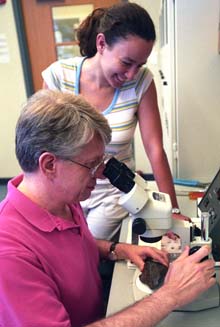
Chondrites are relatively unaltered samples of material from the solar nebula, According to Fegley, who heads the University’s Planetary Chemistry Laboratory, scientists have long believed them to be the building blocks of the planets. However, no one has ever determined what kind of atmosphere a primitive chondritic planet would generate.
“We assume that the planets formed out of chondritic material, and we sectioned up the planet into layers, and we used the composition of the mix of meteorites to calculate the gases that would have evolved from each of those layers,” said Schaefer. “We found a very reducing atmosphere for most meteorite mixes, so there is a lot of methane and ammonia.”
In a reducing atmosphere, hydrogen is present but oxygen is absent. For the Miller-Urey experiment to work, a reducing atmosphere is a must. An oxidizing atmosphere makes producing organic compounds impossible. Yet, a major contingent of geologists believe that a hydrogen-poor, carbon dioxide-rich atmosphere existed because they use modern volcanic gases as models for the early atmosphere. Volcanic gases are rich in water, carbon dioxide, and sulfur dioxide but contain no ammonia or methane.
“Geologists dispute the Miller-Urey scenario, but what they seem to be forgetting is that when you assemble the Earth out of chondrites, you’ve got slightly different gases being evolved from heating up all these materials that have assembled to form the Earth. Our calculations provide a natural explanation for getting this reducing atmosphere,” said Fegley.
Schaefer presented the findings at the annual meeting of the Division of Planetary Sciences of the American Astronomical Society, held Sept. 4-9 in Cambridge, England.
Schaefer and Fegley looked at different types of chondrites that earth and planetary scientists believe were instrumental in making the Earth. They used sophisticated computer codes for chemical equilibrium to figure out what happens when the minerals in the meteorites are heated up and react with each other. For example, when calcium carbonate is heated up and decomposed, it forms carbon dioxide gas.
“Different compounds in the chondritic Earth decompose when they’re heated up, and they release gas that formed the earliest Earth atmosphere,” Fegley said.
The Miller-Urey experiment featured an apparatus into which was placed a reducing gas atmosphere thought to exist on the early Earth. The mix was heated up and given an electrical charge and simple organic molecules were formed. While the experiment has been debated from the start, no one had done calculations to predict the early Earth atmosphere.
“I think these computations hadn’t been done before because they’re very difficult; we use a special code” said Fegley, whose work with Schaefer on the outgassing of Io, Jupiter’s largest moon and the most volcanic body in the solar system, served as inspiration for the present early Earth atmosphere work.
NASA’s Astrobiology Institute supported this work.