


This one’s for the birds.
A study by biologists at Washington University in St. Louis shows that the more diverse a bird population is in an area, the less chance humans have of exposure to West Nile Virus (WNV).
Now, let’s hear it for the birds.
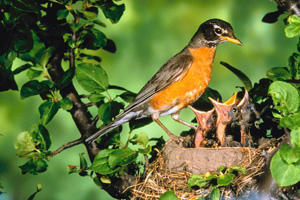
“The bottom line is that where there are more bird species in your backyard, you have much lower risk of contracting West Nile fever,” said Brian Allan, doctoral candidate in biology in Arts & Sciences at Washington University in St. Louis. “The mechanisms are similar to those described for the ecology of Lyme disease. Most birds are poor reservoirs for West Nile Virus, and so mosquito bites taken on them are ‘wasted’ from the perspective of the virus. Where many bird species exist, very few mosquitoes get infected, and so we humans are at low risk. A few bird species are highly competent reservoirs, and these tend to occur in urbanized and suburbanized areas where bird diversity suffers.”
The most common “reservoir” species that urbanites and suburbanites and even rural dwellers in heavily farmed landscapes see are crows, grackles, house finches, blue jays, sparrows and American robins, with the robin being the most prolific carrier of WNV. Robins are anthrophilic — they love being around humans — and it’s relatively easy for mosquitoes to take their blood meals from them because robins feed so much on the ground.
Allan, his advisor Jonathan M. Chase, Ph.D., associate professor of biology, and 14 collaborators from numerous institutions will publish their findings in a forthcoming issue of Oecologia.
While diversity of bird species is important in this scenario, that factor alone doesn’t tell the whole story.
“It’s not just about the number, but their relative proportions,” Allan said. “It’s a combination of richness – the number of species — and evenness — their relative proportions. In urban and suburban areas you see lower species richness and lower community evenness. For instance, you might have five species present, but in 100 animals 90 are just one species. That’s why species number is only half the equation.”
Allan and numerous graduate students began the research five years ago as they just entered graduate school and the topic of West Nile Virus was just beginning to receive lots of attention and the ecology of the organism hadn’t been studied much. They identified a variety of field sites, both urban and rural, with their base of operations at Washington University’s Tyson Research Center, a facility 22 miles west of St. Louis comprised of 2,000 acres of woods, glades and prairie.
They performed bird surveys at the sites, put up a variety of mosquito traps and studied different mosquito species and their ability to transmit the virus. Using kits provided by the Center for Disease Control, they tested the mosquitoes and found three positive pools.
“The infection rates are actually remarkably low, with maybe one in 1,000 carrying WNV,” Allan said.
They expanded their study to include mosquito infection data from the St. Louis City and St. Louis County Health departments. They saw the same patterns. The greater bird diversity, the lesser incidence of WNV; the lesser diversity, the greater likelihood of WNV.
To broaden their finding even more, Allan and his colleagues used national data sets on human cases of WNV and a tool called the Shannon Diversity Index to estimate the diversity of bird populations across the U.S. These data are conducted nationwide by amateur bird watchers for the United States Geological Survey’s Breeding Bird Surveys.
“We’re seeing locally and nationally that bird diversity is a buffer against the occurrence of West Nile Virus in humans,” Allan said. “That’s a win-win situation for both conservation and public health.”