


Radio astronomer and astrophysicist Jocelyn Bell Burnell, Ph.D., the first person to discover pulsars, will describe her landmark work and current research at 11 a.m. Wed., March 19, in Graham Chapel, as part of the Assembly Series. Her talk, “In Pursuit of Pulsars,” is the annual Compton Science Lecture.
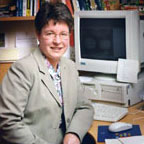
Radio astronomy research began in the 1950s, but was limited until Cambridge University astronomers developed a suitable type of radio telescope. Under the supervision of her doctoral advisor, Anthony Hewish, Ph.D., Burnell was involved in the construction of the telescope and was responsible for the monitoring and interpreting of the transmission recordings.
In 1967, her notice of unusual radio signals led to the detection of the first known pulsar, and was considered the most remarkable astronomical discovery in recent history. The pulsars appeared as an appendix in her doctoral thesis. In 1968, she co-authored two papers on pulsars in the prestigious science journal Nature.
In 1974, Hewish and a Cambridge colleague received the Nobel Prize in physics for the discovery of pulsars. It was the first time the prize was given for work in astronomy.
Burnell was born in Northern Ireland and graduated in 1965 with a bachelor’s degree in physics from the University of Glasgow, followed by a Ph.D. in radio astronomy from the University of Cambridge in 1969.
She is an enthusiastic communicator of science and a role model for women in science. She has taught and conducted research at the University of Southampton and the University College London and the Royal Observatory in Edinburgh. She was dean of science at the University of Bath and taught physics at the Open University (England). She also spent a year as a distinguished visiting professor at Princeton University. She currently holds a visiting professorship in astrophysics at the University of Oxford and is a fellow at Mansfield College, Oxford.
Burnell has received many honors and awards for her contributions to science, including the Michelson Award, the Oppenheimer Memorial Prize, the Tinsley Prize from the American Astronomical Society, the Herschel Medal of the Royal Astronomical Society and the Priestley Award.
In 2002, she was appointed president of the Royal Astronomical Society, becoming the second woman in the organization’s 180-year history to serve in that role.
In 2003, she was made a Fellow of The Royal Astronomical Society for her contributions to astronomy.
The ethical dimensions of science remain important to her. Since her school days, she has remained active in the Religious Society of Friends (Quakers), and maintains a strong commitment to the education of women and the need to encourage dialogue between practicing scientists and the public.
The event is free and open to the public. Graham Chapel is located north of Mallinckrodt Center on the Washington University Danforth Campus.
For more information, call (314) 935-4620 or visit the Assembly Series Web page (http://assemblyseries.wustl.edu).