|
|  |
Washington University in St. Louis News & Information > University Groups >

Arts & Sciences

The humanities, social and behavioral sciences, and physical and natural sciences and mathematics: these form the traditional organizing framework for study of the arts and sciences within a university setting. At Washington University in St. Louis, Arts & Sciences encompasses all these and more, including the study of literature, culture, history, and of economics, political science, education, anthropology, psychology, and the pursuit of scientific knowledge and quantitative reasoning.
In its 40 academic departments and programs, Arts & Sciences has more than 600 tenured and tenure-track faculty whose research interests range across all of human knowledge. In addition, more than 100 research scientists, lecturers, artists in residence, and visitors actively engage in the academic enterprise.
Arts & Sciences' world-class faculty is asking and finding answers to fundamental questions such as: How does life evolve? What causes disease? How does our environment change? By studying foreign languages, literatures and cultures, what might we learn of ourselves? What are black holes? What is the nature of civilization? What does it mean to be an American? How do we explore such questions?
With varied intellectual pursuits, the Arts & Sciences faculty comprising anthropologists, biologists, chemists, economists, historians, political scientists and psychologists — to name just a few — can add perspective and depth to news and feature stories. And the faculty can discuss topics in everyday language and provide an expert source from the Midwest.
| News Stories & Tip Sheets: |
Showing Stories 1 through 3 of 537.
- Show More |
 |
WUSTL flag lowered
 WUSTL flag at half-staff in honor of Richard Hazelton

Nov. 20,
2009 -- Richard M. Hazelton, Ph.D., professor emeritus of English in Arts & Sciences at Washington University in St. Louis, died Friday, Nov. 13, 2009. He was 91.

|
Living in the city
 Urban America focus of national conference at WUSTL

Nov. 9,
2009 -- Washington University in St. Louis will host a national conference on "America's Urban Infrastructure: Confronting Her Challenges, Embracing Her Opportunities" Nov. 19 and 20 in the Danforth University Center. The event, hosted by a consortium of nine WUSTL schools, departments, centers and programs, is free and open to the public.

|
WUSTL flag lowered
 WUSTL flag at half-staff in honor of A. Edward Nussbaum

Nov. 6,
2009 -- A. Edward Nussbaum, Ph.D., professor emeritus of mathematics in Arts & Sciences at Washington University in St. Louis, died Saturday, Oct. 31, 2009, at Barnes-Jewish Hospital. He was 84.

|
Showing Stories 1 through 3 of 537.
- Show More |
 |
| Faculty Experts: |
Showing Experts 1 through 5 of 16.
- Show More |
 |
Richard Axelbaum
 Professor of energy, environmental and chemical engineering

Axelbaum is the Director of the Consortium for Clean Coal Utilization. He also heads the Laboratory for Advanced Combustion and Energy Research and has directed the Engineering section of the NASA Missouri Space Grant Consortium at Washington University in St. Louis since 1997. He served as the associate ...

Expertise: Clean coal, nanoparticles, nanotechnology, materials, synthesis, flames

Direct contact: (314) 935-7560
/
rla@wustl.edu

 |
Robert Criss
 Professor of Earth & Planetary Science

 |
| Criss |
Criss specializes in hydrogeology, the geology of water and systems of water. Much of his work has an environmental slant. He investigates the transport of aqueous fluids in environments such as rivers, cool potable groundwater systems essential to civilization, and deeper, hotter hydrothermal systems. ...

Expertise: Geology, hydrogeology, floods, river systems, dams

Direct contact: (314) 935-7441
/
criss@wustl.edu

 |
Tiffany Knight
 Assistant Professor of Biology

 |
| Knight |
Knight is an ecologist who studies the population ecology of rare and invasive plant species, and addresses questions related to the causes and consequences of their abundances and distributions. Why are some species rare, while their closely related congeners are widespread? How does dispersal ability ...

Expertise: Ecology, biology, plants, ecosystems, habitat

Direct contact: (314) 935-8282
/
knight@wustl.edu

 |
Elizabeth Childs
 Associate professor of art history

Childs' major interests are French 19th-Century visual culture, art, and politics, exoticism (particularly the work of Paul Gauguin), history of photography, and caricature.

Direct contact: (314) 935-5287
/
ecchilds@wustl.edu

 |
James H. Buckley
 Professor of Physics in Arts & Sciences

James Buckley specializes in astrophysical research in high-energy phenomena. His research interests include the origin of cosmic rays, gamma-ray and multiwavelength observations of active galaxies and experimental cosmology.

Expertise: Gamma-Ray, Multiwavelength Observations of Active Galaxies, Experimental Cosmology, Dark Matter Search, Origin of Cosmic Rays, Optical Astronomy, Optical Transients from AGNs and GRBs, …

Direct contact: 314-935-7607
/
buckley@wustl.edu

 |
Showing Experts 1 through 5 of 16.
- Show More |
 |
Why capitalism fails
The Boston Globe

Sept. 15,
2009 -- U. of Georgia historian Stephen Mihm writes about the late WUSTL economist Hyman Minsky, who "has begun emerging as perhaps the most prescient big-picture thinker about what, exactly, we are going through. A contrarian amid the conformity of postwar America, an expert in the then-unfashionable subfields of finance and crisis, Minsky was one economist who saw what was coming. He predicted, decades ago, almost exactly the kind of meltdown that recently hammered the global economy. "

|
Sleep helps reduce errors in memory
United Press International
and 4 others

Sept. 15,
2009 -- Researchers at Michigan State, Chicago, and WUSTL says sleep may reduce mistakes in memory for both the young and the old.
They studied the presence of false memory in groups of college students. Previous research has shown that sleep improves memory, but this study address errors in memory.
The study was published in the journal Learning & Memory.

|
Chimps use 'tool kits' to gather army ants
United Press International
and 3 others

Sept. 10,
2009 -- Researchers led by WUSTL anthropology professor Crickette Sanz in the Republic of Congo's Nouabale-Ndoki National Park said they have discovered chimpanzees that have developed specialized "tool sets" to forage for army ants.

|
Young Animals May Be Able to Erase Bad Memories
U.S. News & World Report online
and 5 others

Sept. 8,
2009 -- New Swiss research published in Science suggests that young animals may have a mechanism that allows them to jettison traumatic memories, but experts say it's unclear whether humans of any age can do the same. Includes comments by WUSTL psychology professor and memory specialist Mark McDaniel.

|
Burqa Furor Scrambles French Politics
The New York Times
and 2 others

Sept. 1,
2009 -- In France, a parliamentary commission will soon meet to investigate whether to ban any cloak that covers most of the face. WUSTL anthropology professor John Bowen, who wrote "Why the French Don't Like Headscarves: Islam, the State and Public Space," has been asked to testify by the parliamentary commission.

|
Additional Information: Arts & Sciences at Washington University is the center for multi-disciplinary activity and world-class intellectual clusters. In the courses and research activities that result from these collaborations, students and faculty work across the boundaries that have demarcated traditional academic disciplines. And so, freshman have an opportunity to study the meaning of the Lewis and Clark expedition from the perspective of a historian, a literature professor, and a plant biologist.
Undergraduates study the scientific and policy issues of our environment, led by an environmental scientist, a political scientist, and an anthropologist. Students and faculty in the Philosophy-Neuroscience-Psychology program seek an integrated understanding of how the mind and brain work by drawing from a variety of disciplines, including the three PNP departments as well as linguistics, education and anthropology.
The majority of Washington University's undergraduates, more than 3,000 each semester, are Arts & Sciences students; but all 5,000 of the university's undergraduates spend at least some of their time in Arts & Sciences classrooms and labs. Students in Engineering, Business, Art and Architecture meet general education requirements by taking courses in the College of Arts & Sciences and many of these students have double majors or minors in an Arts & Sciences discipline as well as in their professional field. About half of Arts & Sciences students go on to medical school, law school or graduate school upon receipt of the Bachelor's degree; the other half find jobs in the widest range of careers imaginable. Its alumni are successful teachers, scientists, writers, doctors, lawyers, business leaders, filmmakers, performing artists, journalists and civic leaders.
In the Graduate School of Arts & Sciences, more than 1,000 students enroll each year in pursuit of the master's and Ph.D. Arts & Sciences graduate students are among the most talented in the country, and as teaching and research assistants make important contributions to the work of the faculty. The Graduate School of Arts & Sciences is nationally renowned for its time to degree statistics and its placement record.
Through University College, each semester Washington University becomes accessible to more than 800 part-time students from the St. Louis community. Summer sessions for current students, visitors and special programs for talented high school students are also administered through University College in Arts & Sciences.
Arts & Sciences is organized in three large parts — The College, The Graduate School and University College, all within the coordination of the executive vice chancellor and dean of Arts & Sciences. Its 40 academic departments and programs are home to world-class faculty who oversee the curriculum and the research agenda. Faculty and students examine fields of knowledge that can be grouped into three basic areas: humanities; social and behavioral sciences; and physical and natural sciences and mathematics.
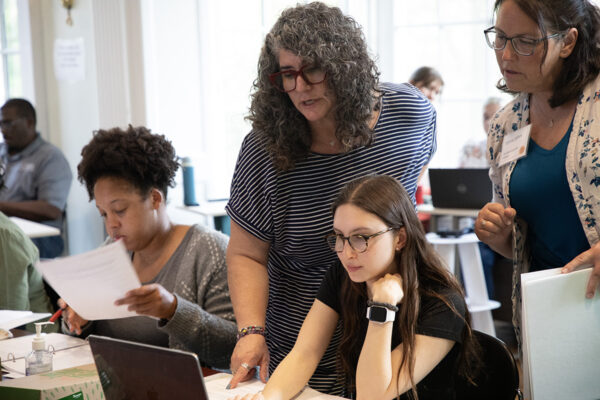
Arts & Sciences at Washington University is about great faculty interacting with great students, exploring important questions. Arts & Sciences is about learning and discovery in the areas critical to human endeavor. In other words, Arts & Sciences is the heart of a great university.
|
|  |
|