|
|  |
Washington University in St. Louis News & Information > University Groups > Arts & Sciences >

Chemistry

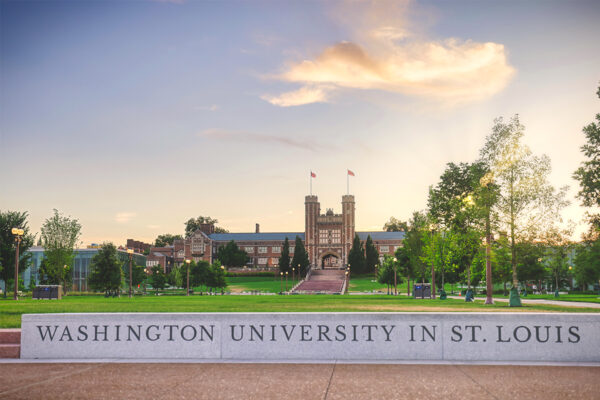
Welcome to the Department of Chemistry of Washington University in St. Louis. We occupy five buildings, of a total size of 242,000 square feet . The Department provides rigorous training in all areas of chemistry at both graduate and undergraduate levels. Approximately 50 chemistry majors graduate each year, many of whom go on to further study at the best graduate schools in the world.
| News Stories & Tip Sheets: |
Showing Stories 1 through 3 of 108.
- Show More |
 |
Cloudy with a chance of pebble showers
 Simulation suggests rocky exoplanet has bizarre atmosphere

Sept. 29,
2009 --
Intrigued by the discovery last February of Corot-7b, a rocky exoplanet, Washington University in St. Louis scientists set out to investigate its atmosphere the only way so-far possible: mathematically and by simulation. Tidally locked with its star and orbiting very close to it, the planet is hot enough to melt rock on its star-facing side. Its atmosphere consists of the components of silicate rocks in gaseous form and, the simulation suggests, periodically rains pebbles or grains of sand onto the molten surface below.

|
Developing 'next generation of creative thinkers'
 Free science camp for middle schoolers from traditionally underrepresented populations

June 12,
2009 --
 |
| WUSTL Photo Services |
| WUSTL's ExxonMobil Bernard Harris Summer Science Camp |
Download
|
Washington University in St. Louis will host its third ExxonMobil Bernard Harris Summer Science Camp June 14-26. The Danforth Campus will welcome 48 middle schoolers from traditionally underrepresented populations who are academically qualified, recommended by their teachers and genuinely interested in math and science. The free residential camp gives students a first-hand experience with experiments, role models and innovative programs to encourage their continued participation in math and science courses in school. A special "ExxonMobil Media Day" will be held from 9:30-11:30 a.m. June 17 at the Mallinckrodt Center, lower level. Campers will work side by side with scientists to complete an engineering challenge.

|
Going platinum
 New catalyst could boost cleaner fuel use

May 14,
2009 --
Material scientists at Washington University in St. Louis have developed a technique for a bimetallic fuel cell catalyst that is efficient, robust and two-to-five times more effective than commercial catalysts. The novel technique eventually will enable a cost effective fuel cell technology, which has been waiting in the wings for decades and should give a boost for cleaner use of fuels worldwide.

|
Showing Stories 1 through 3 of 108.
- Show More |
 |
| Faculty Experts: |
Showing Experts 1 through 5 of 8.
- Show More |
 |
Richard Axelbaum
 Professor of energy, environmental and chemical engineering

Axelbaum is the Director of the Consortium for Clean Coal Utilization. He also heads the Laboratory for Advanced Combustion and Energy Research and has directed the Engineering section of the NASA Missouri Space Grant Consortium at Washington University in St. Louis since 1997. He served as the associate ...

Expertise: Clean coal, nanoparticles, nanotechnology, materials, synthesis, flames

Direct contact: (314) 935-7560
/
rla@wustl.edu

 |
Ralph Quatrano

Ralph S. Quatrano, Ph.D., is the Spencer T. Olin Professor in Arts and Sciences and chair of the Department of Biology at Washington University in St. Louis. He is internationally known for his plant science work on patterns of embryo formation, and how the patterns lead cells to acquire traits or ...

Expertise: Plants, plant biology, botany, moss, genome, algae, genes, …

Direct contact: (314) 935-6850
/
rsq@wustl.edu
 |
Michael Welch
 Professor of radiology

Welch, an expert in synthetic chemistry, has been a leader for more than 30 years in the development of synthetic imaging agents that have allowed doctors to use positron emission tomography (PET) to diagnose an increasingly wide variety of disorders. He is also head of the Radiochemistry Institute ...

Expertise: PET, nuclear medicine, synthetic chemistry, oncology, imaging agents, radioisotopes, radionuclides

Media assistance: (314) 286-0122 / purdym@wustl.edu

 |
William Buhro
 Professor of Chemistry in Arts & Sciences

William H. Buhro, Ph.D., professor of chemistry and associate director of the Center for Materials Innovation, specializes in nanotechnology. He and his group are engaged in synthesis on the nanometer-scale. They design reactions and mechanisms for the growth of inorganic crystals having dimensions ...

Expertise: nanomaterials, materials, inorganic chemistry, nanotubes, nanowires

Direct contact: (314) 935-4269
/
buhro@wustl.edu

 |
Richard Loomis
 Assistant Professor of Physical Chemistry

Richard Loomis, Ph.D., assistant professor of chemistry, is a physical chemist making inroads into high-speed computing. Loomis received his doctorate in chemistry in 1995 from the University of Pennsylvania and then received a prominent National Research Council Postdoctoral Fellowship with the National ...

Expertise: reaction dynamics, atomic resolution, quantum computing, radical molecule clusters, linear laser spectroscopy, nonlinear laser spectroscopy, quantum wave packet dynamics, …

Direct contact: (314) 935-8534
/
loomis@wuchem.wustl.edu

 |
Showing Experts 1 through 5 of 8.
- Show More |
 |
Particles, Molecules Prefer Not To Mix
ScienceDaily.com
and 7 others

May 5,
2009 -- In the world of small things, shape, order and orientation are surprisingly important, according to findings from a new study by WUSTL chemistry professor Lev Gelb, graduate student Brian Barnes, and postdoctoral researcher Daniel Siderius.

|
Novel Technique Changes Lymph Node Biopsy, Reduces Radiation Exposure
ScienceDaily.com

Jan. 14,
2009 -- Information obtained from a new application of photoacoustic tomography (PAT) is worth its weight in gold to breast cancer patients. The work of WUSTL biomedical engineering researchers Lihong Wang and Younan Xia, supported by the NIH, can minimize invasive surgical lymph node biopsy procedures to determine if breast cancer has metastasized and reduce the patient's exposure to radioactivity.

|
Precise Measurement of Phenomenon Advances Solar Cell Understanding
ScienceDaily.com
and 3 others

Nov. 19,
2008 -- Researchers at Washington University in St. Louis have shed light on a basic process that could improve future solar cells.

|
Finding Industry Funding
Science Magazine

March 14,
2008 -- WUSTL's Karen Wooley, professor of chemistry, comments on the difficulties and approaches academic researchers use to garner industry funding.

|
Mimicking plant evolution proves fruitful
MSNBC.com

Jan. 11,
2008 -- By mimicking plant evolution, a team of Illinois researchers has improved upon nature's design to build a leafy energy-producing powerhouse — or at least a virtual one on a supercomputer. In a study published within the journal Plant Physiology, WUSTL biology and chemistry professor Robert Blankenship comments on the Illinois study.

|
Additional Information: Shared departmental facilities include a high-resolution NMR facility, a Mass Spectrometry facility, Computing resources, glass, mechanical and electrical shop services, and numerous other instrumentation.
|
|  |
|